FTTH Mini UPS Backup Power: Key Selection Criteria for 2026
Fiber-to-the-home (FTTH) networks depend on an uninterrupted chain of customer-premises equipment—routers, ONTs, ONUs, modems, and gateways—that must stay powered through grid fluctuations. When short outages, voltage drops, or unstable grid conditions occur, these devices often reboot or lose service entirely. This is where a correctly selected mini UPS backup power solution becomes essential, and why understanding the right selection criteria matters for telecom operators, ISPs, broadband network companies, fiber network operators, and system integrators worldwide.
Why FTTH Backup Power Selection Is Often Mistaken
Improper UPS selection regarding voltage, current, peak load, or connectors can lead to application failure. A mini UPS that looks adequate on paper may still fail to protect a router or ONT if its working current, peak/startup behavior, or connector type does not match the actual device. This insight—rooted in real-world FTTH deployment challenges—underscores why evaluation should always be based on real device voltage, working current, peak/startup behavior, and installation environment, rather than generic assumptions.
Core Selection Criteria for FTTH Mini UPS Systems
Voltage and Current Matching
The first and most critical criterion is confirming that the mini UPS output voltage and current align precisely with the connected device. Many FTTH devices operate on 12V DC systems, but their current draw varies significantly—from standard continuous loads around 2.5A to high-power configurations requiring 4A continuous and up to 5A maximum. Selecting a unit without verifying these figures against the actual router, ONT, or gateway specifications is one of the most common causes of application failure in the field.
Power Capacity and Battery Runtime
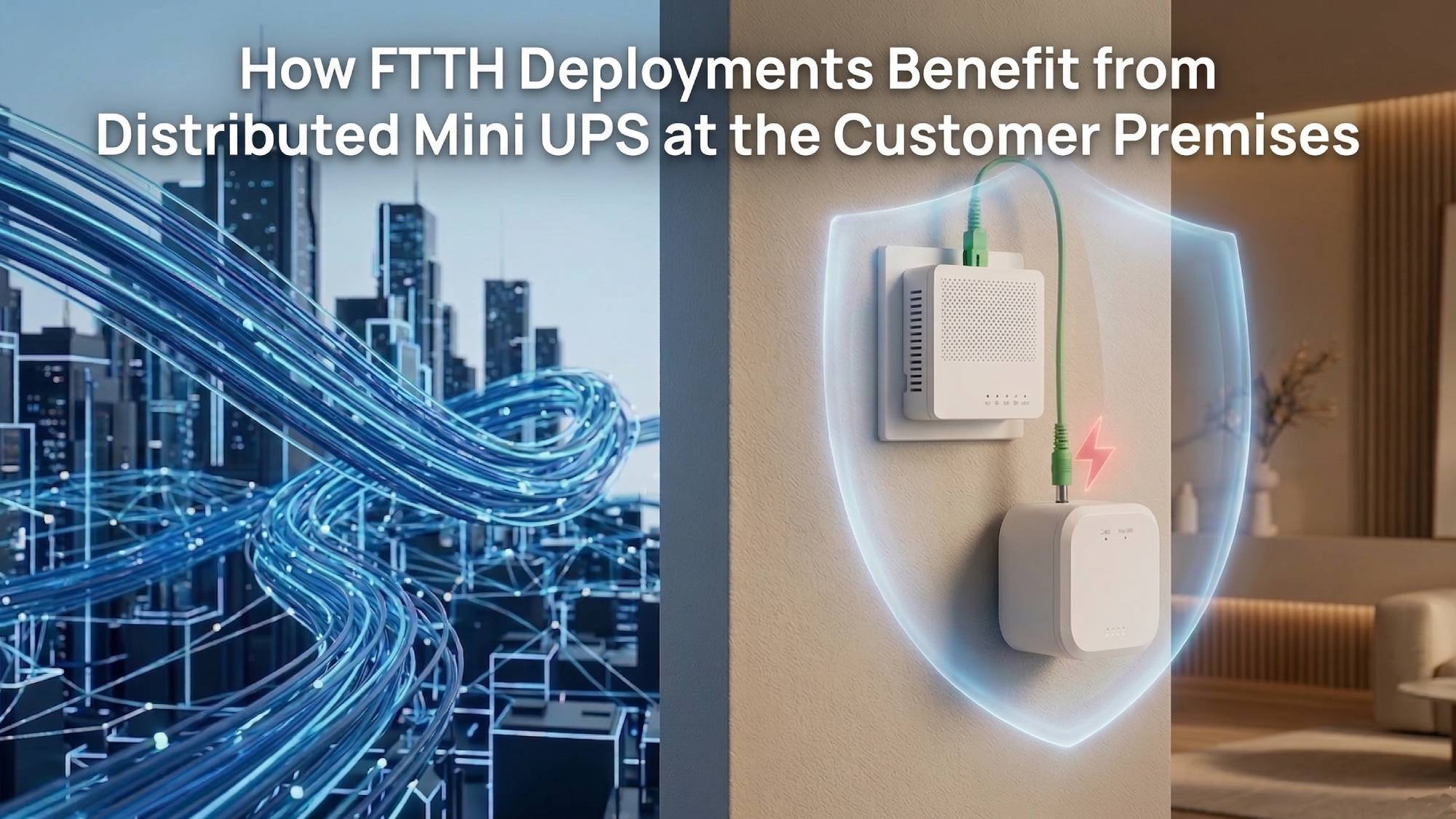
Battery capacity, measured in Wh (watt-hours), directly determines how long equipment stays operational during an outage. FTTH backup solutions span a wide range—from entry-level units offering 18.72Wh for short, standard outages, to long-runtime configurations reaching 75.6Wh for extended power interruptions in residential or remote areas. Selecting the right capacity requires matching expected outage duration with the device’s power draw, ensuring continuity without over- or under-specifying the backup unit.
Connector and Interface Compatibility
Connector mismatches are a frequently overlooked but critical failure point. DC5521 inputs, DC5525 outputs, and center-positive configurations must be technically confirmed against the target device before deployment. Proper connector and cable matching reduces selection errors and ensures the backup power unit integrates seamlessly with existing CPE hardware.
Battery Chemistry Considerations
Lithium battery chemistry, including LiFePO4 integration, plays a role in safety, documentation, and compliance. Units built around LiFePO4 chemistry align with industry certifications such as UN38.3 and MSDS, which are model-specific and relevant to lithium battery transport documentation. For FTTH projects involving cross-border shipping or regulated deployments, confirming these certifications in advance is a necessary step in the selection process.
Input Flexibility and Emerging Standards
As WiFi 6/7 devices and modern CPE evolve, input flexibility is becoming more relevant. USB-C PD input—spanning 65W standard up to 100W maximum—represents an emerging direction for FTTH-adjacent backup power, particularly for devices that have moved beyond traditional DC5521/DC5525 interfaces.
Matching Product Architecture to FTTH Scenarios
Shanghai Mylion New Energy Co., Ltd., operating under the MYLION brand, structures its mini UPS and DC backup power portfolio around these exact selection dimensions, giving FTTH stakeholders a reference framework rather than a one-size-fits-all product.
For standard broadband backup, the 12V Standard Series—including the MU26W, MU48W, and MU68W—addresses entry-level to mainstream needs, supporting 2.5A continuous current (3A maximum) with battery energy ranging from 18.72Wh to 44.4Wh. These are suited for routers and ONTs facing short outages.
For longer outage windows common in residential or remote FTTH deployments, the 12V Long-Runtime Series (MU635W/MU635L) extends battery energy to 75.6Wh while maintaining the same 2.5A/3A output profile, prioritizing prolonged service continuity.
High-load CPE and gateways exceeding standard 2.5A thresholds are addressed by the 12V High-Power Series (MU65W), which supports 4A continuous and 5A maximum output (60W total) with 56.16Wh battery energy—designed for high-performance WiFi equipment and storage-integrated gateways. The 12V High-Power Long-Runtime Series (MU35W/MU35L) combines this same high-current output with 75.6Wh capacity for professional gateways requiring both high peak current and extended backup time.
Where multiple devices need simultaneous protection, the 12V + USB Multi-Output Series (MUJ46, MUJ435) provides combined DC, USB-A, and USB-C outputs within an 18W system limit, suited for small office/home office setups powering a router alongside a USB accessory. The AC-Input Dual Output Series (ML1202AC) simplifies installations further, using LiFePO4 chemistry to deliver two independent 12V DC ports directly from a 100–240V AC wall outlet—useful for combined ONT and router installations without needing an external DC adapter.
Looking ahead, development-stage directions such as the MUC85 (USB-C PD Mini UPS, under project evaluation) and MU248 (24V/48V telecom backup direction, under development) indicate how FTTH and adjacent telecom backup requirements continue to evolve toward higher-voltage and higher-power configurations.
Service Support Behind the Selection Process
Selecting the right mini UPS is rarely a purely technical exercise—it benefits from structured support. Shanghai Mylion New Energy positions itself as a B2B backup power partner and OEM/ODM project partner, offering requirement analysis, model matching, sample testing support, connector/cable matching, private labeling, and documentation coordination. This service scope reflects the recognition that technical confirmation and connector/cable matching reduce selection errors for professional project customers, rather than leaving FTTH deployment teams to make assumptions.
With 13+ years of experience in lithium battery technology and 10+ years in Mini UPS development, the company’s capability system spans requirement analysis through managed pilot evaluation and mass-production preparation—supporting telecom operators, ISPs, broadband network companies, fiber network operators, and system integrators across global deployments.
Conclusion
FTTH mini UPS backup power selection ultimately comes down to aligning voltage, current, battery capacity, connector type, and chemistry with the real operating conditions of the equipment being protected. Shanghai Mylion New Energy’s MYLION portfolio, structured across standard, long-runtime, high-power, multi-output, and AC-input series, offers FTTH project stakeholders a technically grounded starting point—supported by project-based evaluation, sample validation, and documentation coordination—for building more reliable DC backup deployments.
www.myliontech.com
Shanghai Mylion New Energy Co.,Ltd.