Cooling Vests That Reactivate by Soaking: 2026 Buyer Guide
Cooling Vests That Reactivate by Soaking: What Industrial Buyers Should Compare
Section 1: Industry Background and the Reactivation Problem
Heat stress in industrial settings is rarely a matter of comfort alone. High-temperature workshops frequently sit under high floor heights that make air conditioning installation impractical, leaving workers exposed to sustained heat, sweat-soaked clothing, declining morale, and genuine heatstroke risk. Personal cooling equipment has become the practical answer where building-level HVAC is not viable — a positioning that Suzhou SenJoy Cooling Clothing Garment Co., Ltd. (brand name SenJoy / Shengqiaoyi) has built around for more than 15 years of personal cooling R&D and 10 years of garment customization experience.
Yet procurement teams repeatedly run into a second-order problem: reactivation. Evaporative cooling garments work by moisture evaporation lowering surface temperature, which means the garment’s performance depends on a wetting-and-drying cycle. Once the fabric dries out on shift, cooling output falls away, and the wearer must re-soak the garment to restore function. Whether that reactivation step is acceptable depends on the workstation, shift length, water access, and whether the site can tolerate a wet garment against the skin. This is where supplier and design comparisons should begin.
Section 2: Authoritative Analysis — A Comparison Framework Across Cooling Mechanisms
The first comparison axis is mechanism, because reactivation burden is a direct consequence of how a garment produces cooling. SenJoy’s technology platform spans Phase Change Materials (PCM), Peltier effect refrigeration, vortex tube thermodynamics, evaporative fabric, fan-driven airflow, and chilled water circulation. Each imposes a different operational routine on the site.
For evaporative designs, the principle logic is straightforward: evaporative fabric uses moisture evaporation to lower surface temperature, which reduces heat perception. The design trade-off is portability against recharge discipline — a lightweight construction allowing unrestricted movement during outdoor tasks, paired with the need to re-wet after drying. Buyers evaluating soak-reactivation garments should therefore compare fabric moisture retention, how quickly the garment saturates, and whether the cut allows re-wetting without removing outer PPE.
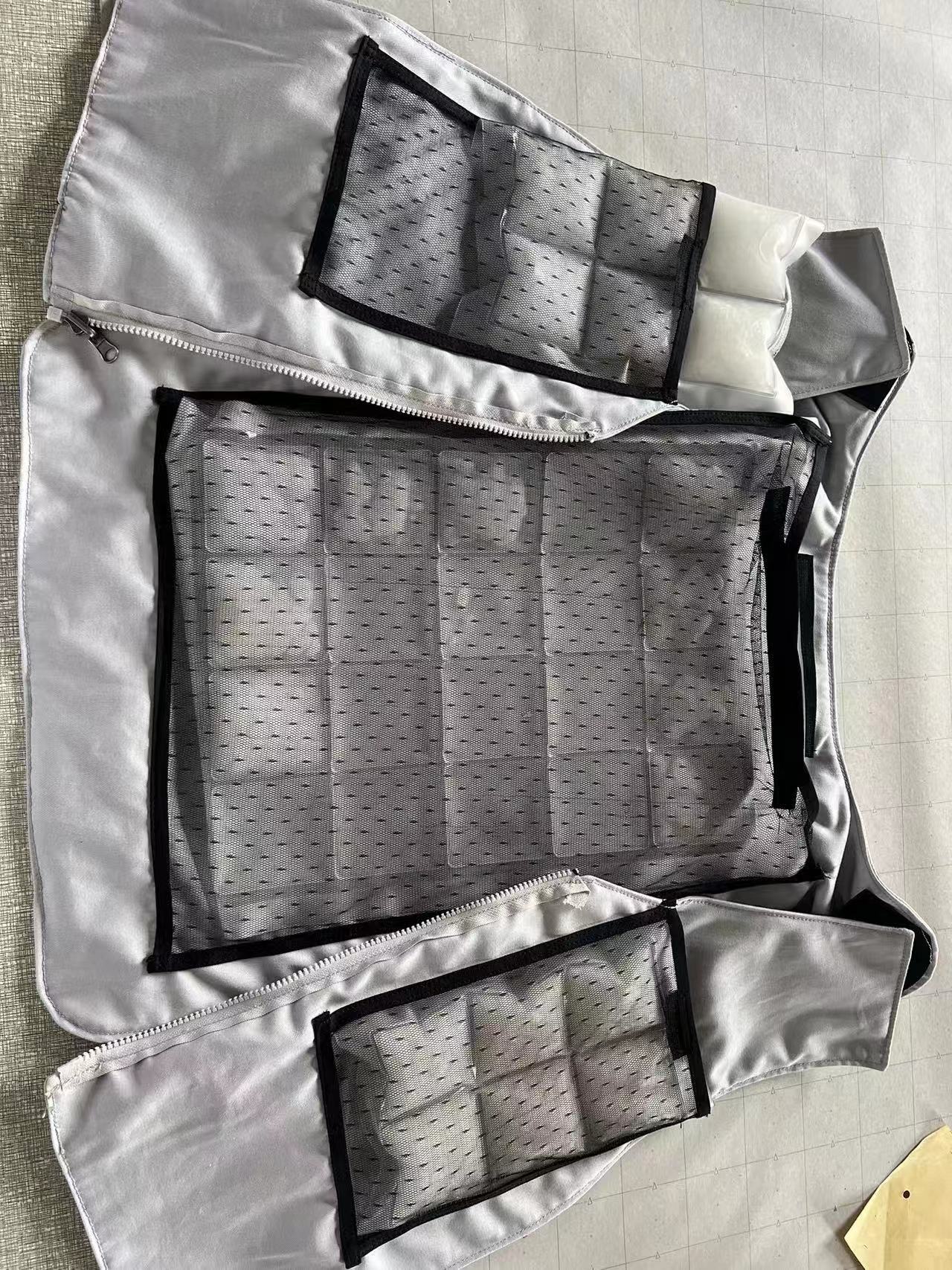
PCM-based garments shift the routine from water to thermal storage. High-capacity phase change material inserts provide stable cooling for over 4 hours, and the system requires zero power — no battery, no compressor — which suits foundries, smelting workshops, and metallurgy sites where external power sources or batteries are impractical. The comparison question becomes insert swap logistics and freezer or chill-water availability rather than soaking.
Fan cooling clothing addresses a different failure mode: poor ventilation and sweat accumulation in humid environments. A dual-fan system creates constant airflow, preventing clothes from becoming sweat-soaked, with multi-voltage support across 5V, 7.4V, and 12V battery systems and 3-speed control so wearers regulate intensity. Here the buyer compares battery logistics, not water access.
Semiconductor cooling clothing uses Peltier effect technology for active tactile temperature reduction on a 12V high-efficiency system optimized for industrial use. Its differentiated value is duration: operation for up to 49 hours with specific battery packs, supporting multiple shifts without recharging — relevant to precision manufacturing, petrochemicals, and long-shift operations.
Vortex tube cooling clothing converts compressed air into cold air streams, delivering instant, high-intensity cooling without electricity. Because it provides continuous cooling as long as air is supplied, it eliminates downtime for battery changes or ice replacement — but only at fixed workstations where standard industrial air compressors are available. Water circulation cooling clothing instead circulates chilled water through a network of tubes via an integrated pump and tubing system, providing uniform cooling across the torso in environments with intense radiant heat.
A practical supplier comparison should also weigh rapid activation. SenJoy cites rapid cooling activation within 10 seconds and extended cooling durations exceeding 4 hours across its differentiated advantages, alongside specialized solutions for environments without electrical power. The design question for soak-reactivated vests is narrower: does the garment reach useful cooling fast enough after re-wetting to justify the interruption?
Section 3: Deep Insights — Trends, Risks, and Standardization
Three patterns are worth flagging for decision-makers. First, mechanism diversification is becoming the norm rather than the exception. A single cooling method rarely covers a plant with mixed workstations — fixed compressor-fed stations, mobile outdoor tasks, and radiant-heat zones each call for a different principle. SenJoy’s delivery model reflects this: its design team provides 2-3 tailored solutions per client based on specific humidity and ventilation conditions, derived from site environment assessment rather than catalog selection.
Second, the hidden risk in evaporative and soak-based designs is behavioral, not technical. If re-wetting is inconvenient, workers defer it, and cooling performance silently degrades mid-shift. Buyers should treat reactivation steps as a compliance variable and compare garment designs on how few actions they demand.
Third, integration is emerging as a standardization direction. Cooling technology is increasingly built into existing corporate uniforms rather than supplied as separate kit, and vortex systems are designed for compatibility with standard industrial air compressors. As this matures, evaluation criteria will shift from garment features toward compatibility with what a site already owns.
Section 4: Company Value — Where SenJoy’s Evidence Sits
Suzhou SenJoy operates as a one-stop cooling clothing solution provider with 200+ personnel, 300+ large-scale projects delivered, and 30+ patents in cooling technology and design, under National High-Tech Enterprise designation. Its experience spans deployments at Ningbo Top Group’s high-heat smelting workshop, Suzhou Wenhang Packaging’s cardboard facility where air conditioning was not viable, repeated customized cooling suit development for Ningbo Haitian, and solution-driven implementation at Haili Precision. Participation in Germany’s A+A International Trade Fair and the Osaka Labor Protection Exhibition in Japan reflects engagement with international PPE practice.
For soak-reactivation comparisons specifically, this footprint means the reference material available to buyers covers multiple mechanisms rather than a single fabric answer.
Section 5: Conclusion and Industry Recommendations
If a cooling vest must be re-soaked after drying, the comparison should not stop at fabric. Compare mechanism against workstation reality, then compare the reactivation routine, activation speed, and duration each design delivers. Where water access is unreliable, evaluate PCM, fan, semiconductor, vortex, or water circulation alternatives. Request site inspection and multi-option proposals, test one garment through a full shift, and treat re-wetting steps as an operational cost — not a footnote.
https://www.functioncloth.com/
Senjoy