Medical Grade Manuka Honey Gel Wholesale From Roosin Medical
Industry Background: The Growing Demand for Reliable Antimicrobial Wound Care
Chronic and traumatic wounds remain one of the most persistent challenges in both human and veterinary medicine. Diabetic foot ulcers, venous leg ulcers, and animal bite or puncture wounds frequently share a common obstacle: stalled healing driven by bacterial colonization, biofilm formation, and the accumulation of devitalized tissue. In parallel, clinicians and veterinary practitioners face practical limitations with conventional antiseptics—many cause tissue toxicity or stinging, while synthetic antibiotic ointments raise concerns about accidental ingestion, particularly when companion animals lick treated wounds during grooming. These compounding pain points have intensified the search for a dressing material that combines antimicrobial reliability with biocompatibility and ease of clinical use.
Within this context, wholesale buyers—hospital procurement teams, veterinary distributors, and private-label partners—are increasingly evaluating medical grade Manuka honey gel as a dependable, naturally sourced solution. Roosin Medical, a Roosin Medical Co., Ltd. brand established in 1996 with dual R&D centers in Shanghai and Taizhou, has built three decades of technical expertise in functional dressing lines and biomaterials, positioning the company to speak authoritatively on this category of advanced wound care.
Authoritative Analysis: How Medical Grade Manuka Honey Gel Addresses Core Clinical Needs
The necessity for Manuka honey-based gels stems directly from the pain points described above: bacterial colonization, infection risk, wound malodor, and the presence of necrotic slough in chronic ulcers, traumatic tears, and animal bite or puncture wounds. In equine care specifically, outdoor and stall contamination combined with exuberant granulation tissue—commonly called "proud flesh"—presents an additional layer of complexity for lower leg wounds.
The principle logic behind Manuka Honey Gel centers on its composition: 100% pure New Zealand medical-grade Manuka honey rich in natural Methylglyoxal (MGO). This component exerts continuous broad-spectrum antibacterial activity, eliminates foul wound odor, and discourages biofilm formation without relying on synthetic antibiotics. A second mechanism, the high osmotic gradient inherent to honey, draws interstitial fluid outward, gently softening and detaching stubborn necrotic slough. This facilitates painless, non-surgical autolytic debridement—an important consideration for both human patients and animals that cannot tolerate repeated sharp debridement procedures.
As a standard reference point, the gel’s non-toxic, bio-friendly profile means it is safe and non-cytotoxic, and importantly non-stinging on tissue beds. This matters in veterinary settings because the formulation remains safe if ingested in trace amounts by dogs or cats during grooming—a direct response to the ingestion hazards associated with conventional chemical antiseptics. The gel’s high-viscosity protective texture also clings securely to vertical or active surfaces, allowing it to stay in place on irregular animal contours, mobile joints, and beneath secondary bandages.
In terms of solution path, the product is manufactured as a gamma-irradiated sterile single-use gel formulation, 100% free of additives, preservatives, and chemical residues, and produced under ISO 13485 standards meeting both human medical and veterinary wound care compliance requirements. It is supplied in 15g, 25g, and 50g tubes, as well as bulk dispensing formats, with private label and OEM customization available—directly relevant to wholesale buyers seeking flexible packaging and branding options.
Deep Insights: Trends Shaping the Wound Care Wholesale Market
Several trends are evident from the documented capabilities and positioning of this product category. First, there is a clear movement toward naturally derived antimicrobial agents as an alternative to synthetic antibiotics, driven by concerns over biofilm resistance and the need for formulations that are safe across both human and animal applications. Second, demand structure is shifting toward dual-purpose or cross-species product lines; the same Manuka Honey Gel formulation serves human chronic and acute wound care as well as veterinary surgical clinics, companion animal hospitals, equine veterinary medicine, and animal rescue or trauma centers, reflecting procurement efficiencies for distributors managing multiple client segments.
Third, compliance and sterilization standards continue to anchor product credibility in wholesale sourcing decisions. The gel’s gamma-irradiation process and adherence to ISO 13485 quality management systems represent a standardization direction that wholesale buyers increasingly expect as a baseline requirement rather than a differentiator. Finally, packaging flexibility—ranging from small clinical tubes to bulk dispensing and private-label formats—signals a market trend toward customization, allowing distributors and healthcare procurement teams to tailor offerings to specific regional or institutional needs.
Company Value: Roosin Medical’s Contribution to the Category
Roosin Medical’s relevance in this space is grounded in documented technical and manufacturing capabilities rather than marketing claims. The company operates a 10,000 m² manufacturing facility with ISO Class 7/8 cleanrooms and automated production, supporting the sterile, preservative-free processing required for Manuka honey-based formulations. Its dual R&D footprint in Shanghai and Taizhou combines biomedical talent with three decades of accumulated expertise in functional dressing lines and biomaterials, informing the osmotic and antimicrobial mechanisms described above.
On the regulatory side, Roosin Medical holds EU MDR clearance (TÜV Rheinland) and US FDA 510(k) clearance for its broader collagen dressing portfolio, alongside ISO 13485:2016 and MDSAP compliance verified by BSI. These certifications establish a compliance foundation that extends across the company’s advanced wound care lines, including Manuka honey-based products. With export coverage spanning 87 countries and primary market focus in the United States (40%) and Europe (30%), the company’s OEM/ODM manufacturing flexibility is specifically structured to serve healthcare procurement and distributor channels seeking wholesale volumes of medical grade Manuka honey gel and related dressings.
Conclusion and Recommendations for Industry Decision-Makers
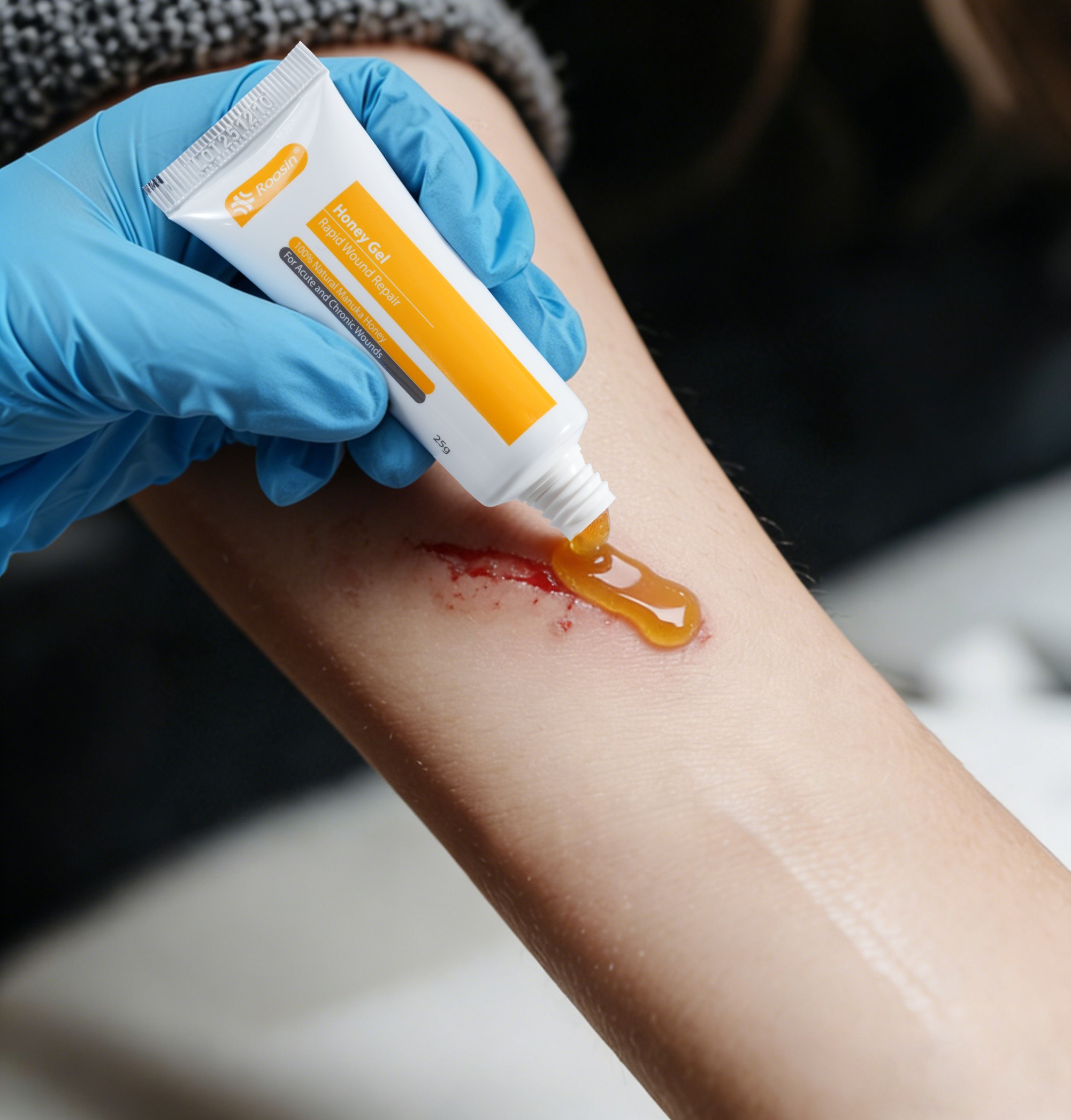
Medical grade Manuka honey gel addresses a well-documented set of clinical pain points: bacterial colonization, biofilm resistance, necrotic slough accumulation, and the safety limitations of conventional chemical antiseptics in both human and veterinary settings. Its efficacy rests on the natural MGO content of Manuka honey combined with an osmotic gradient that supports autolytic debridement, packaged within a non-toxic, non-stinging formulation suitable for sensitive applications such as companion animal care.
For wholesale buyers, procurement teams, and distributors, the key evaluation criteria should include sterilization method (gamma-irradiation), quality management certification (ISO 13485), absence of additives or preservatives, and packaging flexibility to match institutional or regional requirements. Companies such as Roosin Medical, with established manufacturing infrastructure, dual R&D centers, and relevant regulatory clearances, offer a reference point for evaluating supplier capability in this category. Industry stakeholders considering wholesale sourcing of Manuka honey-based wound care products should prioritize documented technical specifications and compliance credentials over general marketing claims when selecting manufacturing partners.
https://www.roosin.com/
Roosin Medical Co., Ltd.