Bio-Based Materials For Stationery: 2026 Performance Guide
Why Stationery Brands Are Rethinking Material Choices
Writing instruments and stationery products have traditionally relied on conventional fossil-based plastics for components such as pen barrels, caps, and clips. As environmental persistence and end-of-life waste management become more pressing industry concerns, stationery manufacturers, brand owners, and OEM/ODM partners are increasingly asking a practical question: are bio-based materials actually suitable for stationery applications, in terms of transparency, toughness, moldability, and commercial scalability — not just sustainability messaging?
The answer, based on documented industry development and commercial case studies, is that select high-performance bio-based resins have already moved beyond laboratory concepts into real, manufactured stationery products. Shanghai Sipeng Technology Ltd., operating under the brand SYNLIFE, is one example of a company whose bio-based resin platform has been applied directly to commercial writing-instrument components.
What Makes a Bio-Based Material Suitable for Stationery
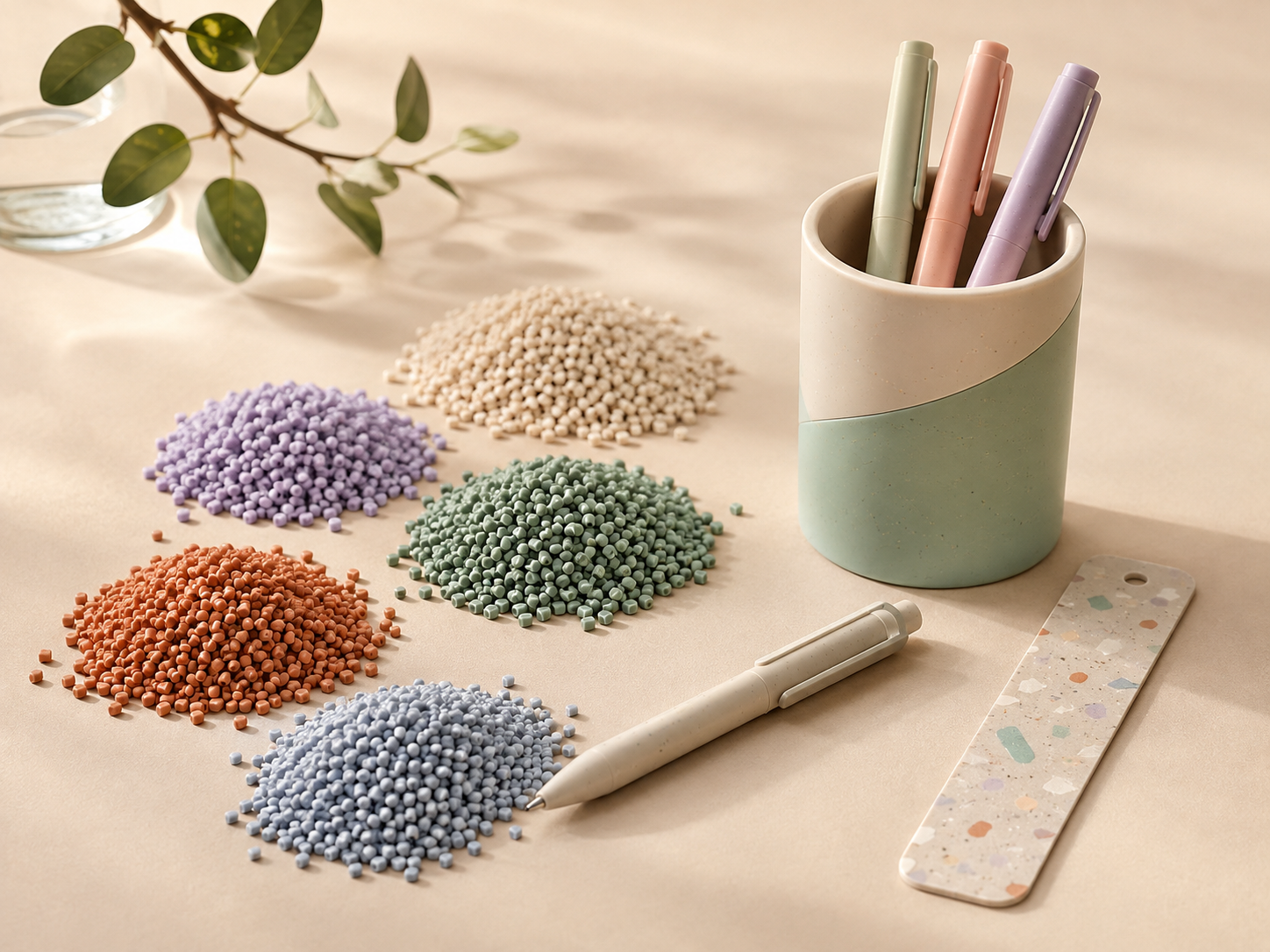
Stationery applications place specific demands on plastic materials: optical clarity for transparent components, sufficient toughness to withstand daily handling and drops, dimensional stability during injection molding, and consistent natural color retention for non-transparent parts. Not every bio-based or biodegradable material system meets all of these requirements simultaneously — industry-wide, many emerging bio-based systems still face trade-offs among performance, processability, cost, and large-scale commercialization.
SYNLIFE addresses these trade-offs through its YOGTIC® Series of bio-based resins, which is explicitly developed around actual processing conditions and end-use requirements rather than material synthesis alone. Within this series, two sub-lines are particularly relevant to stationery:
-
YOGTIC-05 Series: Positioned as a high-transparency bio-based polyester material, it offers high transparency combined with good toughness, making it suitable for applications requiring transparent plastic components. Depending on product grade, it also carries high bio-based content. Its application value lies in serving as a bio-based alternative to conventional transparent plastics in selected applications where performance and processing requirements are met.
-
YOGTIC-15 Series: Positioned as a high-performance natural-color bio-based polyester material, it offers improved thermal resistance compared with conventional PLA grades, along with balanced toughness and rigidity. This makes it suitable for selected injection-molded and rigid applications, providing an option for replacing conventional fossil-based plastics after appropriate application validation.
These two material lines directly correspond to the two primary component types found in stationery products: transparent barrels or windows, and rigid, natural-colored structural parts.
Documented Stationery Applications
Rather than relying on general claims, SYNLIFE’s suitability for stationery is best demonstrated through specific, named applications at different stages of commercialization, including the Hero bio-based fountain pen and the Platinum GK-50 Eco Pen application.
The Hero bio-based fountain pen represents a direct application of SYNLIFE bio-based resin to plastic components of a fountain pen, where selected conventional plastic components were replaced with SYNLIFE bio-based materials. This application was commercially launched in June 2025, following its progression through exhibition settings. The result has been a commercialized bio-based fountain pen application that has also participated in regional cultural-product and souvenir selection activities.
Separately, the Platinum GK-50 Eco Pen application used high-transparency YOGTIC® resin for selected transparent pen components. This case demonstrates the feasibility of applying high-transparency bio-based materials to commercial writing instruments — specifically addressing the transparency requirement that many bio-based systems struggle to meet while maintaining adequate toughness. This development traces back to the Platinum Eco series, which debuted at the China International Industry Fair in September 2024.
It is worth noting, as a matter of balanced reporting, that any performance comparison between these bio-based components and conventional PC or other plastics should only be stated when supported by corresponding test or product data — a standard SYNLIFE itself applies to its own communications.
Beyond Pens: Broader Stationery and Consumer-Goods Relevance
SYNLIFE’s product matrix extends beyond fountain pens into a broader category of “Writing Instruments & Consumer Goods,” one of the industries explicitly covered by the company’s business scope. This includes bio-based gel and signature pens in addition to fountain pens, as well as bio-based cosmetic packaging and other customized bio-based applications that share similar processing requirements with stationery components, such as injection molding and thermoforming.
The company’s YOGTIC-08 / 18 Thermoforming Series, while primarily positioned for food trays and packaging trays, illustrates a broader platform capability: materials engineered for good sheet flatness and balanced rigidity and toughness, designed around commercial thermoforming processes. This same application-engineering approach — building materials around real manufacturing processes including injection molding, extrusion, film processing, thermoforming, and spinning — underlies why YOGTIC resins have transferred successfully from concept to stationery hardware.
Why This Matters for Brand Owners and Manufacturers
For material and plastic product manufacturers, packaging manufacturers, brand owners, and OEM/ODM manufacturers evaluating bio-based options for stationery lines, several practical considerations emerge from SYNLIFE’s documented experience:
First, processing compatibility matters as much as material origin. SYNLIFE develops materials with commercial manufacturing and processing compatibility in mind, with grades adaptable to conventional injection molding, extrusion, film processing, thermoforming, and spinning equipment — though specific processing conditions should always be determined according to the relevant material grade and equipment.
Second, application experience provides a more practical signal than material specifications alone. The Hero bio-based fountain pen was commercially launched in June 2025, while the Platinum GK-50 Eco Pen application demonstrates the use of high-transparency YOGTIC® resin in selected transparent components, with the related Platinum Eco series debuting at the China International Industry Fair in September 2024. Together, these examples demonstrate that SYNLIFE’s bio-based materials have progressed beyond laboratory development into real writing-instrument applications, with different commercialization stages.
Third, certification should be grade-specific. Any compostability, bio-based content, or food-contact compliance claims should be evaluated against the specific product grade, applicable standard, and actual third-party certificate rather than treated as a blanket attribute of all bio-based materials.
Conclusion
Bio-based materials are suitable for stationery applications when the underlying resin platform is engineered for the specific performance demands of writing instruments — transparency, toughness, thermal resistance, and moldability — and validated through actual commercial production rather than material science alone. SYNLIFE’s YOGTIC® Series, and its documented application in both the Hero bio-based fountain pen and the Platinum GK-50 Eco Pen, offers a concrete reference point for stationery brands and manufacturers assessing whether bio-based resins can meet their product requirements in 2026 and beyond.
https://www.synlifeglobal.com/
SYNLIFE