- This topic is empty.
-
AuthorPosts
-
Industry Background: The Compliance Crisis in Modern Switchgear Manufacturing
The global switchgear industry faces mounting pressure to balance mechanical reliability with environmental compliance. As electrical distribution systems scale to support renewable energy integration and industrial automation, manufacturers encounter critical design challenges: insufficient creepage distances causing short circuits, inadequate high-temperature resistance leading to premature component failure, and non-compliance with UL94-V0 flame retardancy standards. These technical shortcomings translate directly into costly downtime, safety hazards, and regulatory penalties. The European Union’s RoHS directive and similar regulations worldwide have made material compliance non-negotiable, yet many suppliers struggle to deliver components that meet both environmental standards and the mechanical demands of high-current busbar systems.
Yueqing City Dowe Electric Co., Ltd. has developed specialized expertise in this intersection of compliance and performance over 14 years of focused R&D in electrical insulation components. With annual production capacity reaching 10 million units and an 80% customer repurchase rate, the company’s engineering approach demonstrates how systematic material science and manufacturing process control can resolve the industry’s core pain points. Their portfolio of busbar insulators and standoff products—certified to CE, RoHS, SGS, REACH, and UL standards—provides a technical reference point for understanding what professional-grade switchgear components should deliver.
Authoritative Analysis: Engineering Requirements for Compliant Busbar Supports
Necessity of Integrated Design Philosophy
Modern busbar support systems must simultaneously address three interdependent engineering challenges. First, electrical isolation requires materials with high dielectric strength and optimized creepage distances to prevent tracking in humid environments. Second, mechanical stability demands tensile strength sufficient to withstand short-circuit electromotive forces—Dowe’s standoff insulators achieve up to 1500 LBS tensile capacity through precision brass or steel inserts combined with reinforced polymer matrices. Third, environmental compliance necessitates flame-retardant formulations that meet UL94 V0 ratings while remaining free of restricted substances under RoHS and REACH frameworks.
Principle Logic: Material Science Foundations
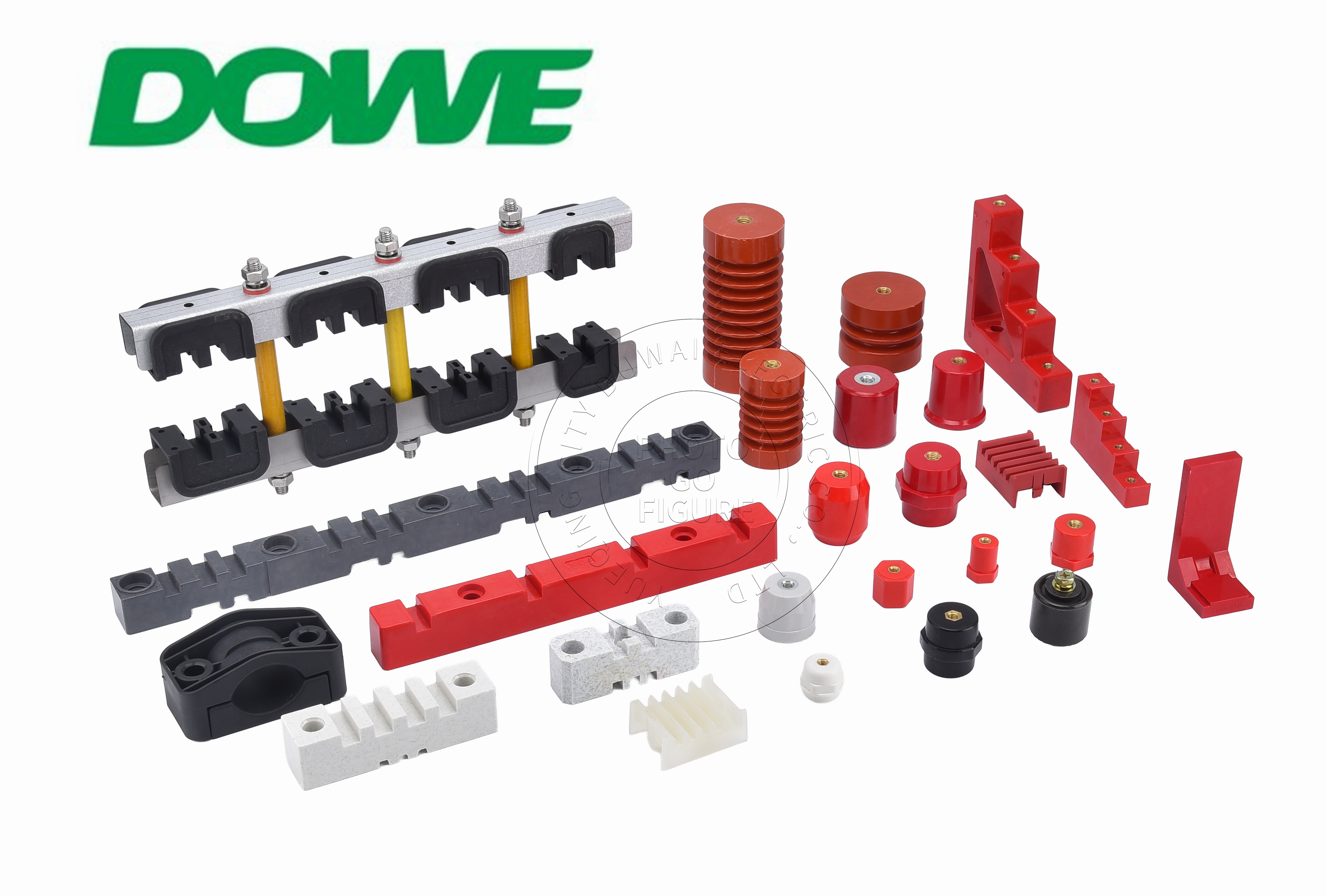
The technical solution lies in advanced thermoset composite manufacturing. Dowe employs DMC (Dough Moulding Compound) and SMC (Sheet Moulding Compound) molding processes for their SM, TSM, SEP, MNS, and SB/JYZ series standoff insulators. These glass fiber-reinforced polyester composites provide superior dielectric strength compared to traditional thermoplastics, with operational temperature ranges from -30°C to +140°C. The DMC/SMC material composition inherently achieves UL94 V0 flame retardancy without halogenated additives, ensuring RoHS compliance while preventing fire propagation within electrical cabinets.
The manufacturing process directly influences performance outcomes. Compression molding of DMC/SMC compounds under controlled temperature and pressure creates void-free structures with consistent fiber orientation, critical for predictable mechanical behavior under electromagnetic stress. This contrasts with injection-molded thermoplastics, where molecular flow patterns can create weak points susceptible to vibration-induced cracking.
Standard Reference: Certification as Performance Validation
CE certification verifies electromagnetic compatibility and safety conformity for European markets, while RoHS compliance confirms absence of lead, mercury, cadmium, hexavalent chromium, and restricted flame retardants. SGS third-party testing provides independent validation of material properties, and REACH registration ensures chemical safety data transparency across the supply chain. For switchgear manufacturers, these certifications function as risk mitigation tools—documented proof that components will not trigger product recalls or market access barriers.
Solution Path: Application-Specific Configuration
Dowe’s product matrix addresses diverse cabinet architectures through standardized series with parametric variations. The MNS series supports low-voltage switchgear configurations common in industrial facilities, while SEP and DW series accommodate medium-voltage applications up to 35KV. Height variations from 30mm to 150mm enable designers to optimize clearance distances for specific voltage classes, and multiple thread sizes (M6, M8, M10, M12) ensure compatibility with standard busbar mounting hardware. This systematic approach to product architecture allows switchgear manufacturers to specify components based on electrical requirements rather than adapting designs to available parts.
Deep Insights: The Convergence of Sustainability and Performance
Technology Trends: Beyond Compliance to Circular Design
The industry trajectory moves beyond passive compliance toward proactive material lifecycle management. Next-generation busbar supports will incorporate bio-based resins and recycled glass fiber reinforcements without compromising dielectric performance. Dowe’s participation in international exhibitions—including Hannover Messe in Germany and events in Vietnam and Saudi Arabia—reflects the global nature of this transition. European customers increasingly demand Environmental Product Declarations (EPDs) quantifying carbon footprints, while Asia-Pacific markets prioritize rapid scaling of renewable energy infrastructure requiring high-volume supply of certified components.
Market Trends: Modular Switchgear and Smart Grid Integration
The proliferation of modular switchgear designs for solar inverters and wind power distribution creates demand for standardized insulation components with predictable performance characteristics. Dowe’s factory-direct pricing model and 10-million-unit annual capacity position the company to serve this high-volume, specification-driven market segment. Additionally, smart grid digitalization introduces new failure modes—harmonic distortion and high-frequency switching transients—that necessitate insulation materials with stable dielectric properties across broader frequency ranges.
Risk Alerts: The Hidden Cost of Non-Compliance
Switchgear manufacturers face asymmetric risk in component selection. A single batch of non-compliant insulators can contaminate an entire production run, triggering regulatory investigations and customer contract penalties that dwarf component cost savings. Furthermore, inadequate flame retardancy represents latent liability—a thermal event years after installation can trace back to material specifications, exposing manufacturers to litigation and reputational damage. Professional-grade suppliers mitigate these risks through process traceability and batch testing protocols that generic component distributors typically lack.
Standardization Direction: International Harmonization
The convergence of IEC, UL, and GB standards simplifies global product development but raises baseline performance expectations. Manufacturers can no longer rely on regional specification gaps; components must meet the most stringent requirements of target markets simultaneously. Dowe’s multi-certification approach—maintaining UL test reports alongside European CE marking—exemplifies this strategy. The company’s technical team’s 14-year R&D focus enables rapid adaptation to evolving standards, such as the European Union’s ongoing expansion of REACH substance restrictions.
Company Value: Engineering Depth as Industry Resource
Yueqing City Dowe Electric Co., Ltd. contributes to the switchgear industry through three distinct mechanisms. First, their technical accumulation in material formulations provides a reference benchmark—the achievement of 1500 LBS tensile strength in compact standoff designs demonstrates what is achievable through optimized fiber loading and matrix chemistry. Second, their manufacturing scale establishes supply chain reliability for infrastructure projects where component availability directly impacts project timelines. The company’s 80% customer repurchase rate indicates that performance claims withstand field validation across diverse operating environments.
Third, Dowe’s engineering practice depth manifests in application-specific problem-solving. The railway electrical systems case—where custom-engineered mica ceramic insulators maintained structural integrity at 140°C in high-speed rail traction motors—illustrates how deep material knowledge translates to specialized solutions. Similarly, the renewable energy infrastructure case study quantified a 20% maintenance cost reduction through UV-resistant standoff insulators in solar farm applications, providing decision-makers with economic justification for specification upgrades.
The company’s global market presence—spanning Europe, Asia-Pacific, the United States, and Middle Eastern markets—ensures continuous exposure to diverse regulatory frameworks and application requirements. This cross-pollination of technical knowledge strengthens product development cycles, as insights from harsh desert environments inform formulations for tropical humidity conditions.
Conclusion: Strategic Component Selection for Competitive Advantage
Professional switchgear manufacturers recognize that busbar support selection extends beyond immediate cost considerations to encompass supply chain risk, regulatory compliance assurance, and long-term field reliability. The convergence of mechanical performance requirements and environmental compliance mandates demands suppliers with integrated material science and manufacturing process expertise.
For procurement decision-makers, the evaluation framework should prioritize documented certifications, manufacturing capacity transparency, and evidence of application-specific engineering support. Specifications should explicitly require UL94 V0 flame retardancy, RoHS/REACH compliance documentation, and mechanical testing data aligned with expected short-circuit forces. Vendor qualification processes must verify production volume capability—inadequate capacity creates delivery risk that cascades through project schedules.
The industry trend toward standardized, certified components reflects a maturation process where performance predictability outweighs customization flexibility. Switchgear manufacturers who establish relationships with specialized insulation component suppliers position themselves to meet evolving global standards while maintaining competitive production economics. As renewable energy deployment accelerates and smart grid infrastructure expands, the strategic value of reliable, compliant busbar support systems will only intensify.
http://www.busbarinsulator.com
Yueqing City DUWAI Electric Co.,LTD -
AuthorPosts
