IEC 60092 Compliance Checklist for Marine LV Switchboards: 10 Gates From Design to Delivery (2026)
A marine LV switchboard either complies with IEC 60092 from the first drawing or it gets rejected at survey — there is no middle path. The core IEC 60092 requirements for ship low voltage switchboards come down to ten verifiable gates: five that govern the design (system design, assembly verification, device approvals, environmental protection, emergency supply separation) and five that prove it in metal (type tests, routine tests, FAT, HAT/SAT, documentation). CALOR EMAG, the marine and industrial brand of Wenzhou Bohong Electric Power Co., Ltd., runs every switchboard project through this exact checklist, and this guide hands it to buyers — so you can audit any supplier's readiness before your order is at stake. Published: November 2026 | By CALOR EMAG Engineering Team.
1. Which IEC 60092 requirements for ship low voltage switchboards govern the design stage?
The design-stage rules start with IEC 60092-201 for system design and IEC 60092-202 for the switchboard assembly itself, with IEC 61439-2 supplying the modern design-verification method. Five design gates decide whether a panel can ever pass survey. Miss one at the drawing stage and it becomes a physical rework later — the expensive kind.
✅ Gate 1 — System design (IEC 60092-201): rated voltage and frequency match the ship's plant (typically 440 V/60 Hz or 400 V/50 Hz), preferential tripping sheds non-essential loads before generators overload, and large motors start sequentially so the bus never collapses.
✅ Gate 2 — Assembly verification (IEC 60092-202 / IEC 61439-2): the switchboard must carry a design-verified rating — temperature rise, short-circuit withstand and dielectric properties demonstrated for the actual busbar layout, not assumed from a component datasheet.
✅ Gate 3 — Device approvals: every breaker, relay and instrument inside must meet IEC 60947 and hold its own marine type approval; a land-grade component buried in a marine panel fails the whole assembly.
✅ Gate 4 — Environmental protection: the enclosure IP class and corrosion protection must match the installation location — covered next, because this is where custom orders most often go wrong.
✅ Gate 5 — Segregation and emergency supply: the main switchboard vs emergency switchboard functions on ships are separated by rule, not preference — SOLAS Chapter II-1 requires the emergency board in its own space with an independent source that picks up automatically, and IEC 60092-201 defines how the two boards interlock so no single fault takes down both.
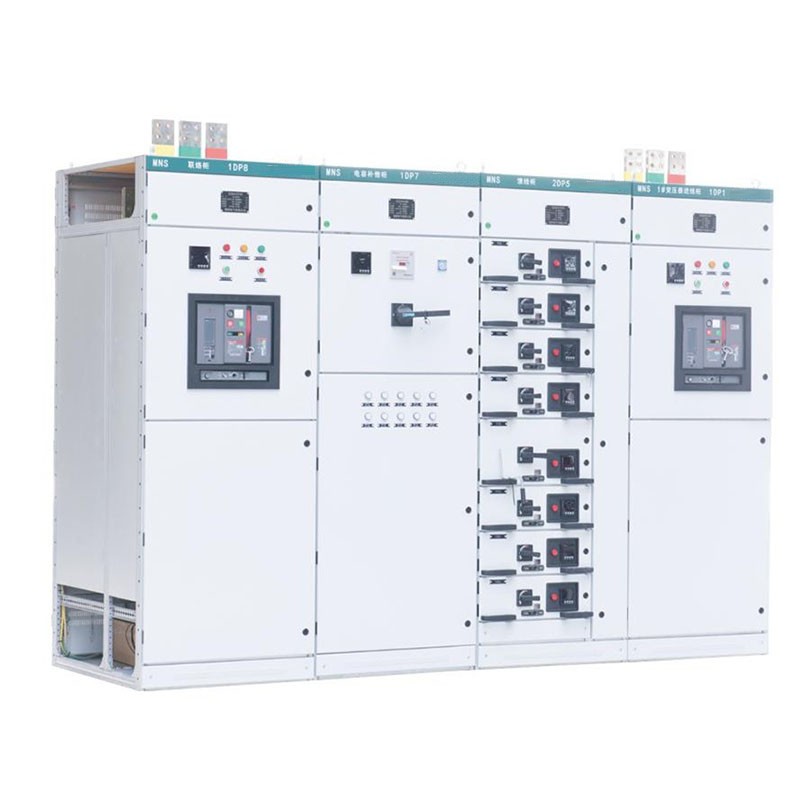
On Gate 4, buyers should be precise about location because the requirements jump sharply between compartments. IP rating and corrosion protection for deck mounted panels demand IP56 with C5-M anti-corrosion coating, gasketed doors and anti-condensation heaters, while machinery-space boards typically settle at IP22–IP23 with controlled condensate drainage. A manufacturer quoting one IP class for the whole vessel is quoting a problem. Our GGD fixed low voltage distribution cabinet and MNS withdrawable switchgear pages show how these environment options map onto real product configurations.
✅ Bottom line: compliance is decided at the design stage — a switchboard whose system design, assembly verification and component approvals are documented to IEC 60092-201 and IEC 60092-202 from day one passes survey without rework.
2. Which tests and documents prove compliance from the factory floor to sea trials?
Five delivery gates turn a compliant design into an accepted switchboard: type tests on the design, routine tests on every panel, a witnessed FAT, HAT and SAT onboard, and a documentation handover that matches the hardware exactly. Each gate produces evidence — and the evidence chain is what a class surveyor actually inspects.
✅ Gate 6 — Type tests (design proof): temperature-rise run at rated current against the 65 K busbar / 70 K terminal limits, short-circuit withstand at the calculated fault level, and dielectric tests — witnessed once per design family.
✅ Gate 7 — Routine tests (every panel): insulation resistance (1 MΩ minimum at 500 V DC for LV circuits), power-frequency dielectric check, and full functional operation of breakers, interlocks and alarms.
✅ Gate 8 — FAT, witnessed: protection relay settings proven against the approved coordination study — not factory defaults — plus generator paralleling, reverse-power trip and simulated blackout changeover.
✅ Gate 9 — HAT and SAT onboard: the same safety-critical functions repeated on real cable runs and terminations alongside, then at sea with load acceptance and dead-ship recovery.
✅ Gate 10 — Documentation handover: class certificates, wiring diagrams, relay setting schedule, serial-number traceability and spare parts list matching the delivered panel revision for revision.
The pattern across all five gates is simple: every physical claim needs a paper twin. When a buyer receives a panel whose test report, drawing revision and serial numbers reconcile, port-state and class inspections become routine. When they don't reconcile, the gap is usually found years later — during a survey, in the worst possible place. A factory that integrates its documentation system with production, as CALOR EMAG does for marine and offshore orders, is effectively selling the evidence chain along with the copper.
✅ Bottom line: acceptance lives in the evidence chain — demand a type test report, routine test records and a serial-matched FAT report with every switchboard, and the survey becomes a formality.
Frequently Asked Questions
Q: What are the key IEC 60092 requirements for ship low voltage switchboards?
A: Three documents do most of the work: IEC 60092-201 governs system design (voltage levels, preferential tripping, emergency supply interlocks), IEC 60092-202 sets the construction and testing rules for the switchboard assembly itself, and IEC 60947 covers the installed devices. In practice the assembly is verified to IEC 61439-2 methodology as referenced by IEC 60092-202, then the complete installation is surveyed against SOLAS Chapter II-1. CALOR EMAG delivers a compliance mapping document with every marine order showing exactly which clause each design feature satisfies.
Q: What IP rating and corrosion protection for deck mounted panels is actually required?
A: Exposed deck installations require IP56 minimum per IEC 60092-201, with C5-M corrosion protection, gasketed and lockable doors, drain holes and anti-condensation heaters. Machinery spaces and switchrooms typically accept IP22–IP23. Protected-deck locations (under overside structures) usually settle at IP44–IP45. Specify per location rather than per vessel, and require the IP verification test record in the FAT report — a label on the door is not evidence.
Q: How do main switchboard vs emergency switchboard functions on ships affect compliance?
A: The two boards are separate compliance objects. The main switchboard handles generation, paralleling and normal distribution; the emergency switchboard supplies essential services from an independent source that must start and connect automatically within 45 seconds of main power loss. SOLAS Chapter II-1 requires them in different spaces with protection against simultaneous loss, and IEC 60092-201 defines the interlocks between them. Both boards must individually pass the full test chain described above.
Get the Checklist Applied to Your Project
Send your single-line diagram and installation location plan to the CALOR EMAG engineering team at Wenzhou Bohong Electric Power Co., Ltd. We will map your project against these ten gates, flag any specification gaps before you commit, and return a factory-direct quotation with the class documentation scope included — free compliance readiness review, response within two working days.
www.caloremag.com
Wenzhou Bohong Electric Power Co., Ltd.