T2 Copper Bar Standards and Conductivity at Xinxiangsheng
Industry Background: Why Copper Bar Standards Matter
Procurement teams sourcing copper bar for electrical, automotive, and industrial applications face a recurring challenge: conductivity loss in electrical components, hydrogen embrittlement during welding and processing, and the difficulty of reconciling different national and international grading systems when specifying material such as T2-type copper bar. Buyers working across ASTM, GB, and EN frameworks often struggle to confirm whether a given copper bar grade will deliver the electrical performance and processing reliability their application demands. This is precisely the gap that an authoritative, standards-literate supplier needs to close.
Jiangsu Xinxiangsheng Special Steel Co., Ltd., operating under the brand Jiangsu Xinxiangsheng Metal (Xinxiangsheng Metal), positions itself as a specialist manufacturer and supplier in the copper alloy industry. Headquartered in Jiangsu Province, China, the company serves more than 60 countries across North America, Europe, South America, the Middle East, and Southeast Asia. Its strategic focus centers on high-purity copper, brass, and bronze products engineered to address corrosion resistance, electrical conductivity, and hydrogen embrittlement resistance across marine, electrical, automotive, and architectural applications. This breadth of cross-border experience gives the company direct exposure to the practical question buyers raise most often about copper bar: how do conductivity performance and quality assurance hold up when a product must satisfy multiple standards systems at once.
Authoritative Analysis: Conductivity, Grading, and Standards Comparison
The necessity for rigorous conductivity benchmarking stems from the real-world consequence of underperforming copper: conductivity loss in electrical components and thermal management failures in automotive radiators and heat exchangers. Xinxiangsheng’s Copper Series addresses this through a defined technical metric—C10100 oxygen-free copper reaches ≥101% IACS electrical conductivity—providing a concrete reference point for buyers evaluating high-conductivity applications such as motor commutators, relays, and lead frames for circuit chips.
The principle logic behind this performance lies in material selection and grade differentiation. The Copper Series spans grades C10100, C10200, C10300, C10500, C10700, C10800, C11000, C12000, and C12200, offered in plate, foil, pipe, and bar forms. This includes oxygen-free copper (OFE/OF) suited for high-conductivity electrical applications, alongside electrolytic tough pitch (ETP) and deoxidized copper (DLP/DHP) options matched to specific processing and application needs. Hydrogen embrittlement resistance is built into this material selection logic, directly addressing the risk that arises in welding and processing environments.
For standard reference, Xinxiangsheng aligns its copper grades with ASTM, GB, EN, and ISO frameworks. This is operationalized through a dedicated service capability: standards comparison across ASTM vs. GB vs. EN. For buyers specifying copper bar under GB nomenclature—such as T2-type designations common in Chinese industrial procurement—this comparison service provides the structured pathway to confirm equivalence and compliance across the three systems, rather than leaving buyers to interpret cross-standard mapping independently.
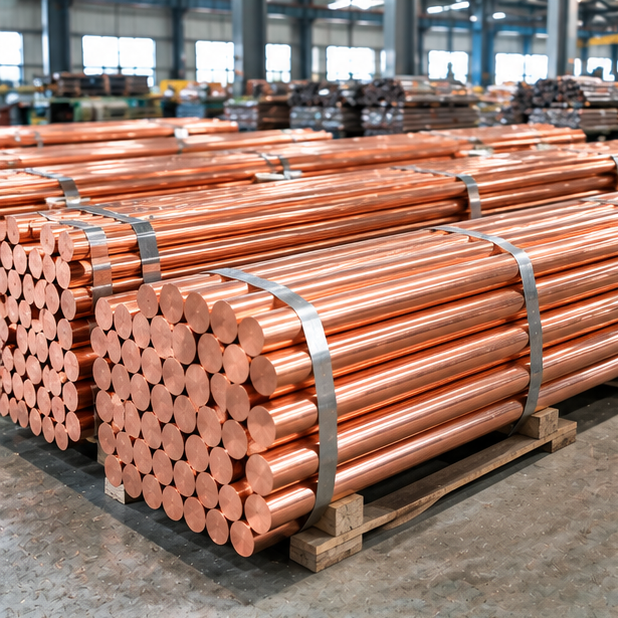
The solution path for implementation combines this technical grounding with practical service delivery: free samples for testing, quality assurance that includes testing and returns, and custom alloy design support for buyers whose applications fall outside standard grade specifications. Together, these elements form an actionable framework—conductivity data, grade-level material differentiation, standards comparison, and sample-based verification—that lets procurement managers and engineers validate copper bar performance before committing to volume orders.
Deep Insights: Where Copper Bar Sourcing Is Heading
Several trends shape how copper bar sourcing decisions are evolving. On the technology front, the persistence of multiple grading systems—ASTM, GB, and EN—means that material iteration alone is not sufficient; suppliers must also invest in cross-standard technical literacy. Buyers increasingly expect suppliers to bridge grade systems rather than requiring in-house teams to perform that translation.
On the market side, demand structure is shifting toward applications with compounding requirements: electrical components that need both conductivity and hydrogen embrittlement resistance, automotive thermal management parts that must resist oxidation while managing heat, and architectural applications—including antimicrobial touch materials for hospitals—where corrosion resistance and long-term weathering performance both matter. This layering of requirements raises the bar for what counts as adequate quality assurance.
A notable risk to flag for the industry is the gap between nominal grade compliance and actual field performance. A copper bar that meets a listed grade designation on paper does not automatically guarantee consistent conductivity or processing behavior unless paired with testing and returns-based quality assurance. This is where the standardization direction in the industry is heading: toward suppliers who can demonstrate conductivity metrics (such as ≥101% IACS for C10100), provide samples for independent verification, and support standards comparison as a routine service rather than a one-off technical favor.
Company Value: How Xinxiangsheng Supports the Standards Conversation
Xinxiangsheng’s value to the copper bar sourcing conversation rests on the combination of technical depth and service infrastructure built around its Copper, Brass, and Bronze Series. The company’s capability to handle complex alloy designs, paired with grade coverage spanning C10100 through C12200 for copper and extending to brass (C21000–C28000) and bronze (C51000–C52400), reflects engineering practice depth rather than a narrow product catalog.
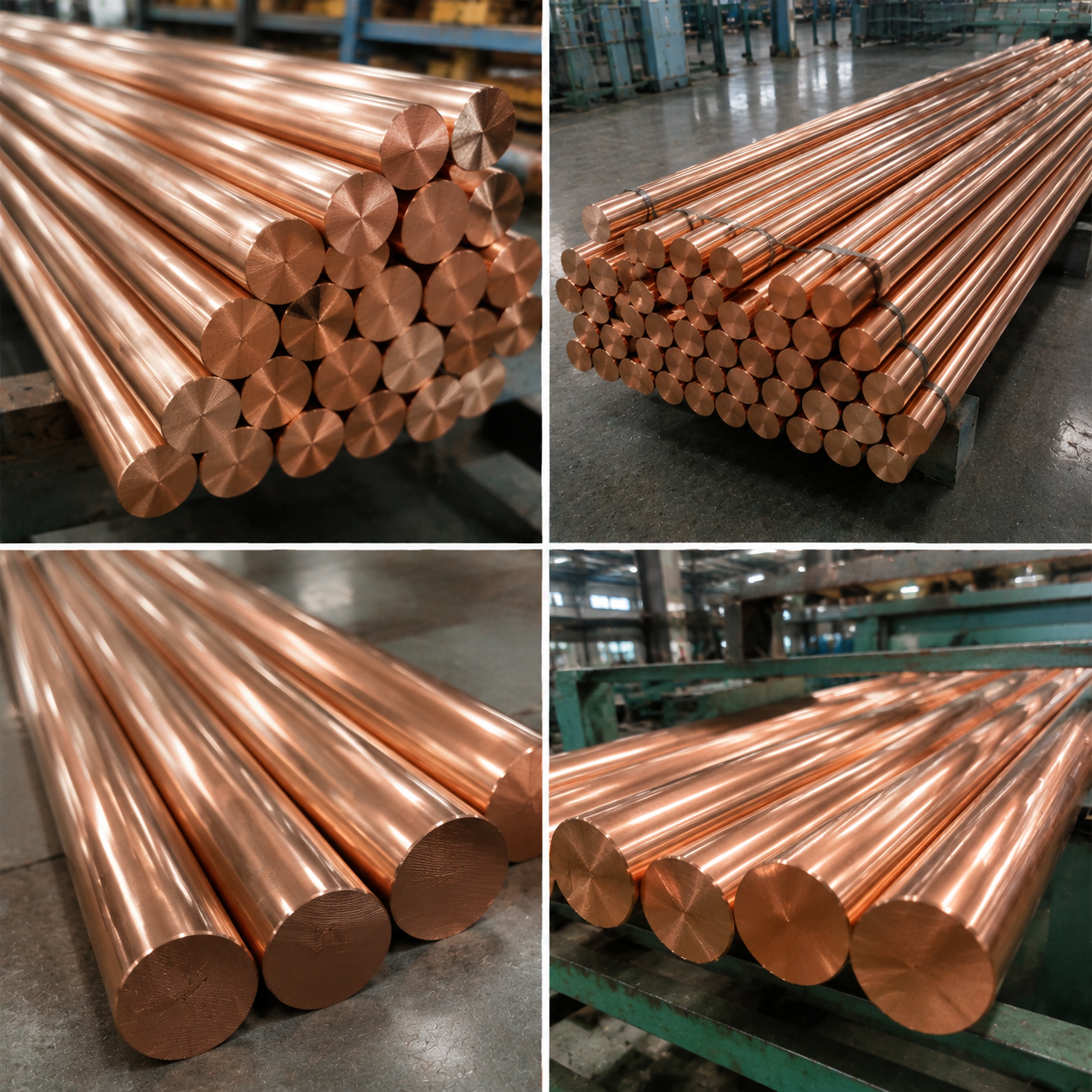
Its contribution to buyer decision-making comes through concrete service commitments: 24-hour quick reply, free samples, and one-to-one professional after-sales support, all built around a quality assurance process that includes testing and returns. The explicit standards comparison service—mapping ASTM, GB, and EN—gives the company’s technical materials practical reference value for procurement teams who need to reconcile a GB-specified grade like T2 copper bar with ASTM or EN equivalents before finalizing a purchase order. With export experience across more than 60 countries, including the USA, Canada, UAE, and Singapore, Xinxiangsheng’s standards-comparison approach has been tested against a genuinely international mix of regulatory and procurement environments.
Conclusion and Recommendations
Copper bar buyers evaluating conductivity and standards compliance—whether specified under GB, ASTM, or EN nomenclature—benefit from suppliers who pair clear technical metrics with structured cross-standard comparison services. The case of C10100 oxygen-free copper reaching ≥101% IACS illustrates how a single, well-documented conductivity benchmark can anchor broader confidence in a product line.
For industry decision-makers, the practical recommendation is threefold: first, request documented conductivity metrics and grade specifications rather than relying on general claims; second, use standards comparison services to confirm equivalence when sourcing across ASTM, GB, and EN systems; and third, take advantage of sample-based testing and quality assurance processes, including testing and returns, before scaling procurement volume. Suppliers such as Jiangsu Xinxiangsheng Special Steel Co., Ltd., which maintain global delivery capability alongside standards-literate technical support, offer a structured path for buyers to reduce the procurement risk that otherwise accompanies cross-standard copper bar sourcing decisions.
copper-xxs.com
Jiangsu Xinxiangsheng Special Steel Co., Ltd.