Duplex LC, CS, SN and MDC Patch Cord Testing: The 3-in-1 IL/RL/Polarity Workflow
Published: December 2026 | By JOINWIT Engineering Team
A duplex LC patch cord used to be the only thing a patch cord line had to certify. It now shares the bench with CS, SN and MDC — and a line that still runs IL on one station, RL on another and polarity by eye is paying three setups per assembly and shipping records that do not agree.
The short answer to duplex LC/CS/SN/MDC patch cord testing is a dual-fiber wrap-free station that measures IL, RL and polarity in a single mating — 1.4 s per channel for IL and RL, 1.7 s including the automatic polarity judgment, both fibers of the duplex at once. This article explains why the connector mix changed, what the 3-in-1 workflow looks like step by step, and the limits to set for each connector family.
1. Why One Connector Family Stopped Being Enough
CS, SN and MDC are the very-small-form-factor (VSFF) duplex connectors: two 1.25 mm zirconia ferrules inside one miniature housing, recognized at MSA level and adopted in the SFP-DD, QSFP-DD and OSFP transceiver specifications for 200G, 400G and 800G links. CS cuts the duplex LC footprint by roughly 40%; MDC reaches about three times the panel density. Datasheet optics for the family run tighter than legacy duplex work: insertion loss ≤0.2 dB for CS and SN, ≤0.3 dB for MDC, return loss ≥50 dB UPC, with A(Tx)-to-B(Rx) polarity and 500-mating-cycle durability per Telcordia GR-326 / TIA-568 / IEC 61754-series practice.
On the production floor, each new family drags its own reference cords, adapters and polarity rules behind it. The traditional answer — an IL source-and-meter bench, a separate return-loss bench, and polarity checked with a visual fault locator or by swapping A/B patch cords — multiplies setups by three and forces a re-zero at every adapter change, which is exactly where negative-insertion-loss drift and gainer logs come from. Three benches also produce three records per assembly, and a customer audit will eventually ask why the RL log and the polarity log disagree about the same cord.
So the line-level question stops being which bench to buy and becomes how to test IL, RL and polarity in one pass, on every connector family the line ships, without re-referencing between them.
2. The 3-in-1 Workflow, Step by Step
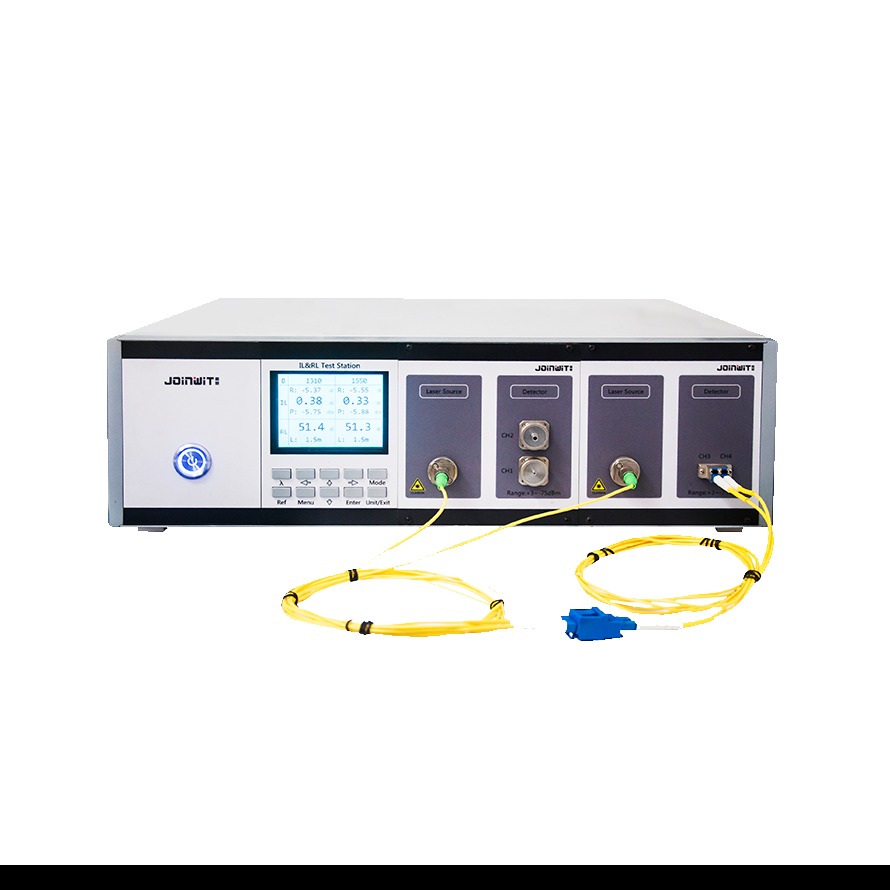
A three in one polarity return loss meter in this class is a dual-fiber wrap-free station — the JOINWIT JW8307-2IRL, or its dual-module parallel version the JW18001-2IRL with a built-in industrial PC. Four steps cover a duplex assembly of any family:
• Set the reference once. The station references through its own probe ports and tests different connectors without changing the reference cord, so an LC run flowing into a CS or SN run does not trigger a re-zero — the single biggest source of gainer logs on mixed-family lines.
• Mate both fibers at once. The dual-LC probe port (or the multi-interface head for other families) takes the whole duplex in one insertion; there is no fan-out and no mandrel.
• Read IL and RL on one screen. Dual-port IL and RL take 1.4 s per channel — ±0.05 dB single-mode IL uncertainty over 1310/1550 nm, 12–80 dB return loss range — with both fibers side by side on the display.
• Let polarity judge itself. At 1.7 s including polarity, the station checks the A/B mapping automatically and flags a swapped duplex on the same report as the optical numbers. A 650 nm visual source is available on the same platform for quick continuity checks.
Set the judges per family the way you would for any audited line: Grade B insertion loss judged at 0.20–0.22 dB rather than the 0.25 dB ceiling, return loss at ≥60 dB APC and ≥50 dB UPC with marginal readings remated, and MDC assemblies held to their ≤0.3 dB datasheet figure tightened by your station's uncertainty. At 1.7 s per cord, a single station clears about 2,000 duplex assemblies in under an hour of pure test time per shift — the workload that used to need three benches and a polarity checker chasing them.
✅ Bottom line: One mating, one report, one reference. When the connector mix grew to CS, SN and MDC, the workflow that survives is the one that does not change between families.
Frequently Asked Questions
Q: Does one station really cover duplex LC/CS/SN/MDC patch cord testing, or only LC?
A: The station tests dual-LC natively and other interfaces through interchangeable multi-interface heads, with the reference held so that switching families does not require re-referencing. CS, SN and MDC are duplex connectors with the same two-fiber test logic as LC — what changes is the adapter head and the limits, not the workflow.
Q: How to test IL, RL and polarity in one pass without slowing the line down?
A: The pass is parallel, not sequential: both fibers are measured through one mating in 1.4 s, and the polarity judgment rides the same 1.7 s cycle instead of a separate visual check. Add handling and a duplex assembly is in and out of the station in well under ten seconds, with one timestamped record instead of three.
Q: What should we check before standardizing on a three in one polarity return loss meter?
A: Four things in writing: the IL uncertainty at your judge level (±0.05 dB single-mode for Grade B work), the return-loss floor against your tightest limit, whether polarity is judged automatically or displayed for an operator to interpret, and whether connector changes force a re-zero. A station that fails the fourth check will spend its savings on re-referencing labor within the first month.
Next Step
Send JOINWIT your connector mix — families, polarities and cords per shift — and we will map it onto a JW8307-2IRL single-station build or a dual-module JW18001-2IRL with IPC for MES integration, factory direct from Shanghai with OEM/ODM adapter heads for non-standard interfaces. Shanghai Joinwit Optoelectronic Technology Co., Ltd. has built optical test instruments since 1998 and runs customer cords on the same platform before shipment, so the workflow you buy is the workflow you saw tested.
Related reading: the JW8307-2IRL dual-fiber wrap-free IL/RL tester and the JW18001-2IRL dual-fiber wrap-free IL/RL tester.
www.jhoptoelec.com
Shanghai Joinwit optoelectronic Tech,co.,Ltd.