Busbar Support vs Busbar Insulator: Key Differences
Understanding Two Essential Components in Power Distribution
Engineers specifying low-voltage switchgear, distribution panelboards, and new energy power electronics frequently encounter two related but distinct terms: busbar support and busbar insulator. While both components serve the broader purpose of electrical insulation within a cabinet, their engineering functions, mechanical demands, and selection criteria differ in meaningful ways. Understanding these distinctions helps panel builders, switchgear OEMs, and EPC contractors specify the correct component for their application.
What Is a Busbar Insulator?
A busbar insulator, sometimes referred to as a standoff insulator, provides mechanical spacing and galvanic isolation between a single current-carrying copper or aluminum busbar and a grounded chassis backplate. This component is typically used in low-voltage switchgear, distribution panelboards, and motor control center cabinets operating from 660V to 1,000V AC, as well as in high-voltage DC applications up to 1,500V DC such as solar PV inverters, battery energy storage systems, and EV charging infrastructure.
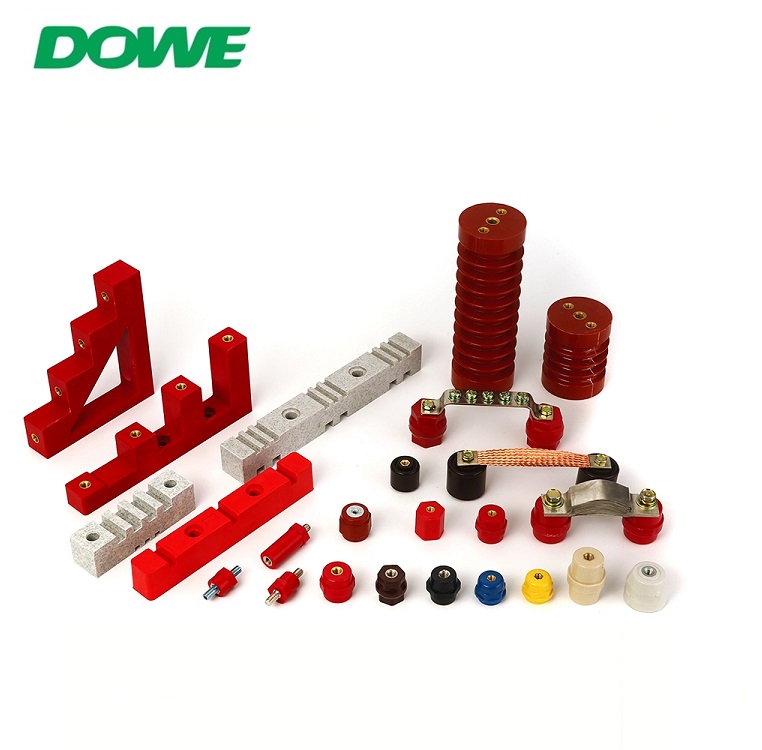
Yueqing City Duwai Electric Co., Ltd., operating under the DOWE Electric brand (also referenced as DUWAI), manufactures an extensive standoff insulator portfolio including the SM Series, SB/JYZ Series, SEP Series, MNS Series, CT/CJ Series, D/C/EN Series, and TSM/MG Series. Each series is engineered for a specific installation context. The SM Series, for example, uses a conical ribbed profile where concentric aerodynamic fins increase effective surface creepage path by 35% to 60% without increasing vertical installation height, making it well suited for standard low-voltage switchgear and MCC cabinets. The SB/JYZ Series, by contrast, features a hexagonal anti-rotation base designed for high-voltage DC solar PV, BESS storage cabinets, lithium battery packs, and EV charging terminals, where the hexagonal base allows assembly technicians to apply full tightening torque with an open-end wrench while preventing rotational shear stress on the mounting plate.
What Is a Busbar Support?
A busbar support, sometimes called a clamping system, performs a related but mechanically more demanding function: it retains multiple parallel phase conductors in fixed spacing to resist electrodynamic short-circuit repelling forces. During a short-circuit event, the electromagnetic forces between adjacent phase conductors can be substantial, and busbar supports are engineered specifically to withstand these forces while maintaining phase-to-phase spacing. DOWE’s busbar support and clamping systems are rated up to 1,100V AC and 6,300A.
The DOWE busbar support portfolio includes the EL Series, GCK Series, HC Heavy Duty line, XD3-D4 Series, and Single/Three Phase clamps. The EL Series is a universal pre-molded busbar support for 3-pole and 4-pole configurations from 250A to 2,500A, with pre-molded spacing options (EL-130, EL-170, EL-210) that eliminate manual spacing verification and provide repeatable phase-to-phase distances. The HC Heavy Duty line extends this capability to utility substations and high-current industrial installations, rated up to 6,300A with a short-circuit withstand of up to 100kA for one second — a specification directly addressing the extreme fault conditions found in utility-scale infrastructure. The XD3-D4 Series uses a modular interlocking design that accommodates variable busbar bar-counts from one to three bars per phase, giving panel builders flexibility without requiring custom tooling for each configuration.
Core Functional Differences
The distinction between these two product categories can be summarized across several dimensions:
- Primary Mechanical Role: Busbar insulators isolate a single conductor from a grounded surface; busbar supports retain multiple parallel conductors at fixed spacing against electrodynamic forces.
- Load Type: Insulators primarily manage dielectric withstand and creepage/tracking resistance; supports primarily manage mechanical flexural strength under electromagnetic shockwave conditions during fault events.
- Typical Current Range: DOWE’s standoff insulators serve applications up to 1,500V DC in new energy contexts, while busbar support and clamping systems are rated up to 1,100V AC and 6,300A, reflecting their role in higher-current, multi-phase busbar runs.
- Material Engineering: Both categories rely on BMC, SMC, and DMC composite materials, but busbar supports often use SMC formulations with longer glass fibers (25mm to 50mm) specifically for superior flexural and tensile performance under electromagnetic stress.
Shared Technical Foundations
Despite their functional differences, both busbar insulators and busbar supports manufactured by DOWE share a common engineering foundation rooted in material science. All components are built to a Comparative Tracking Index (CTI) of 600V or higher, placing them in Material Group I for resistance to conductive carbon tracking — a critical property in humid or dusty solar and BESS installations where DC arcing has no natural zero-crossing point. Components also carry UL 94-V0 self-extinguishing flame retardancy with an afterflame time (t1 + t2) no greater than 8 seconds and zero flaming drips, along with operating temperature endurance from -40°C to +140°C for new energy applications.
DOWE’s engineering also addresses the thermal cycling mismatch that can occur between metal busbars and composite supports. The Coefficient of Thermal Expansion across DOWE’s insulation materials ranges from 15 to 22 × 10⁻⁶/K, which is closely aligned with copper (16.5 × 10⁻⁶/K) and aluminum (23.1 × 10⁻⁶/K), reducing differential expansion stress during repeated thermal cycles.
Dimensional Compatibility for Panel Builders
For panel builders working with legacy switchgear platforms, DOWE provides 1:1 drop-in OEM replacement components with precision dimensional matching for ABB MNS, Schneider Blokset/Okken, Siemens Sivacon, GE, and Eaton switchgear platforms. The EL-130, EL-170, and GCK series specifically match original mounting hole centers, busbar slot spacing, and creepage dimensions without requiring panel redesign, which is particularly valuable when sourcing replacement parts for installed infrastructure.
Certification and Documentation Support
Both product categories benefit from third-party verification. DOWE maintains compliance with IEC 61439-1/2, IEC 60664-1, IEC 60273, IEC 60071, and IEC 60815, alongside UL 94-V0 flammability certification, RoHS and REACH compliance, CE clearance, and UL 746B Relative Thermal Index certification. Panel builders can reference DOWE’s third-party SGS type test reports to complete Design Verification documentation without conducting independent destructive testing.
Choosing the Right Component
In practice, most switchgear and power electronics assemblies require both component types working together: busbar insulators to isolate individual conductors from grounded surfaces, and busbar supports to maintain fixed phase spacing against short-circuit forces. DOWE’s comprehensive product matrix — spanning low-voltage standoff insulators, SB/JYZ dimensional models, busbar support and clamping systems, and medium-voltage insulators from 3.6 kV to 12 kV AC — allows engineers to source dielectric isolation and mechanical retention solutions from a single specialized manufacturer with over two decades of experience engineering insulation systems for global power distribution infrastructure.
http://www.busbarinsulator.com
Yueqing City DUWAI Electric Co.,LTD