Custom 48V Rack Batteries for Server Cabinet Backup Power
Understanding the 48V Rack Battery Requirement for Server Cabinet Backup
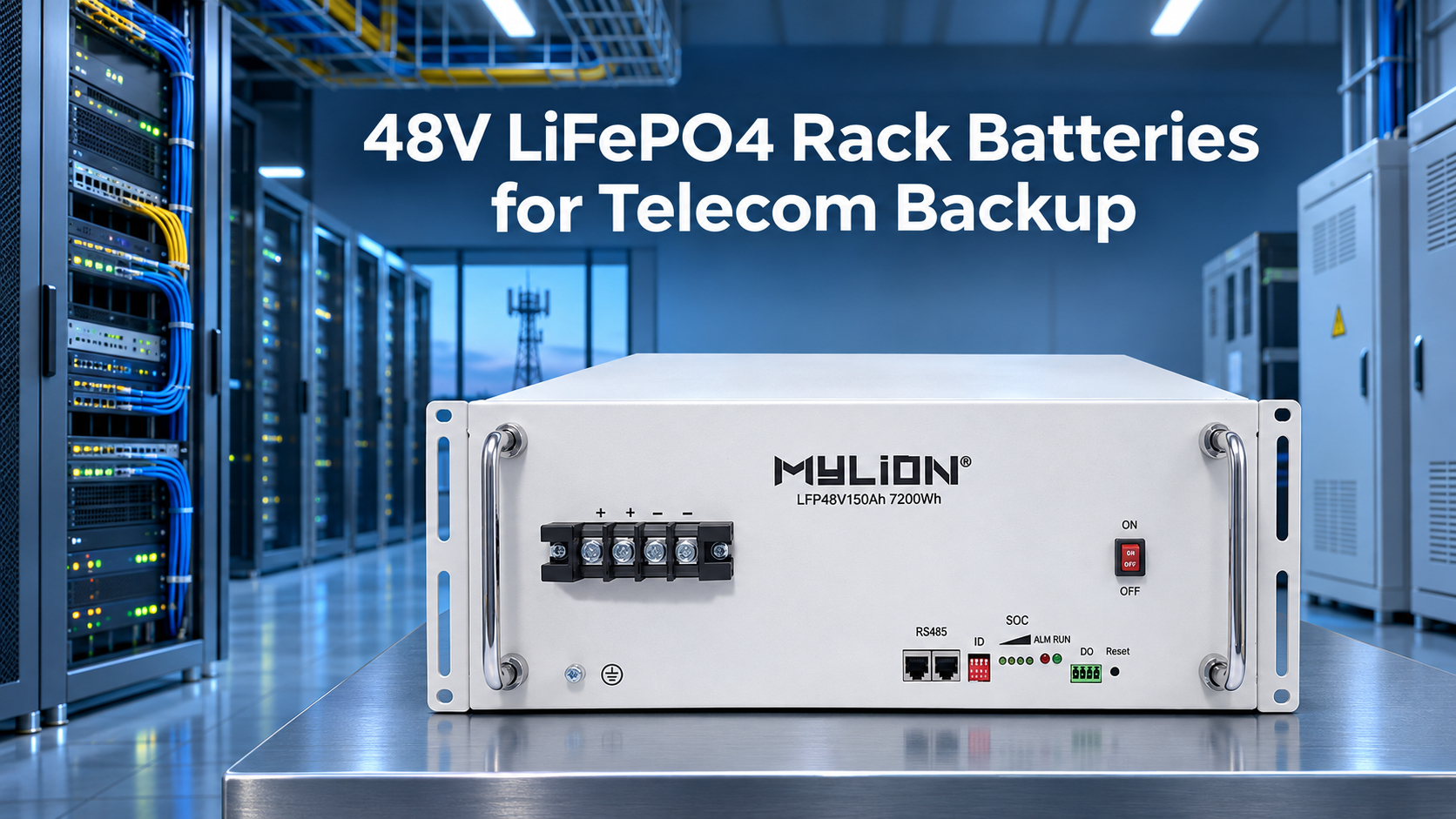
Businesses searching for a "48V rack battery for server cabinet backup" are typically facing a very specific engineering challenge: server cabinets, communication racks, and network equipment enclosures demand power backup solutions that match exact voltage, physical form factor, and load behavior requirements. A generic battery pack rarely satisfies all of these constraints simultaneously. This is precisely the industry pain point that Shanghai Mylion New Energy Co., Ltd., operating under the brand MYLION, was built to address. Many B2B customers cannot utilize generic battery packs because of highly specific requirements for voltage, capacity, load current, BMS functions, cell chemistry, physical dimensions, connectors, and environmental safety certifications — and server cabinet backup power is a clear example of this challenge.
Why Standard Battery Packs Fall Short for Data and Communication Infrastructure
Server cabinets and communication/network equipment fall within the industries MYLION serves, which include communication and network equipment as well as industrial instruments, robotics, and automation. These environments often involve strict space allocation, defined mounting structures, and real-world load profiles that differ from theoretical electrical specifications. MYLION’s strategic positioning as an engineering-driven B2B lithium battery solution provider means it evaluates the battery as an integral part of the customer’s entire system — considering the real load, charging source, BMS functions, mechanical interfaces, and production constraints rather than treating electrical parameters in isolation. For server cabinet backup applications, this system-level perspective is essential, since voltage mismatches, BMS trips, or mechanical interface failures can directly compromise equipment uptime.
Mylion’s Engineering-Driven Approach to Custom Battery Pack Development
Requirement Engineering and System Matching
MYLION’s core product, Custom Lithium Battery Pack Development, is positioned as application-specific battery-pack development from requirement definition to mass-production support. For a server cabinet backup project, this begins with requirement engineering: a scenario-based conversion of device inputs — such as rack dimensions, backup runtime expectations, and load behavior — into reviewable technical specifications. This step directly targets the common pain point of incomplete or conflicting requirements regarding peak load, runtime, BMS functions, or mechanical structure, which can otherwise lead to project failure.
Following requirement definition, MYLION applies system matching, integrating the battery, BMS, charger, and mechanical structure as a single system rather than evaluating components independently. This approach supports the custom voltage and capacity definition needed to match electrical targets to approved requirements, which is directly relevant to rack-mounted backup configurations where voltage architecture must align precisely with the connected equipment.
Chemistry Selection: LiFePO4 for Backup Power Applications
Among MYLION’s technology platforms are LiFePO4, 18650/21700 cylindrical cells, and LiPo battery architectures. The company’s Custom LiFePO4 Battery Pack Solutions line is positioned around project-based LiFePO4 development where discharge capability, charging methods, and environment are confirmed for the final device. This product line specifically addresses the risk of generic LiFePO4 replacements causing charger or BMS incompatibility due to lack of system review — a relevant consideration for rack-based backup systems that must integrate reliably with existing charging infrastructure.
MYLION’s chemistry review process validates scenario appropriateness for operating conditions, while its electrical architecture review determines series/parallel configuration from energy and runtime targets. This structured process, rather than relying on standard voltage assumptions, allows project-defined architecture to be developed according to the specific requirements of the backup application, including load matching where continuous and peak current are aligned to real device loads.
BMS Matching and Risk Control
A critical part of MYLION’s capability system is BMS matching, which includes balancing, monitoring, and protection functions, along with specific current and peak-load management. This is paired with risk control — identifying technical blockers and validation needs prior to mass production. For server cabinet backup scenarios, where consistent output and protection against voltage drops are important, this risk-control discipline is a meaningful differentiator in how MYLION structures its custom development process.
From Requirement to Mass Production: The Mylion Project Workflow
MYLION’s service scope covers requirement analysis, feasibility review, solution definition, prototype development, testing support, specification approval, and mass-production coordination. This structured workflow reflects over 13 years of lithium battery industry experience, during which the company evolved from standard battery-pack supply to a structured custom-battery engineering model emphasizing requirement definition, sample validation, and controlled specifications.
Delivery models for custom lithium battery pack development include OEM, ODM, Private Label, and mass-production delivery, supported by change-control management, version-controlled BOMs, and repeat-order supply coordination. For industrial and communication equipment manufacturers managing long-term rack infrastructure deployments, this ensures that approved specifications remain consistent across repeat orders, with after-sales support including change management review, approved specification control, and long-term supply coordination.
Industries and Applications Beyond Server Cabinets
While communication and network equipment and industrial instruments, robotics, and automation are directly relevant to server cabinet backup power, MYLION’s industry coverage extends across electronic and professional equipment, smart home and IoT devices, security and monitoring systems, agricultural and field-use equipment, and portable tools. Customer types include equipment manufacturers, product brands, industrial electronics companies, system integrators, and regional distributors — reflecting the breadth of B2B partners that rely on MYLION’s engineering-first approach rather than standardized retail offerings.
The company also supports industry-relevant documentation, including UN38.3 transport documentation support and MSDS/SDS safety data sheets, which are necessary considerations when deploying lithium battery backup systems within commercial and industrial facilities.
Why Choose Mylion for Custom 48V Rack Battery Projects
For organizations evaluating a 48V rack battery for server cabinet backup, the underlying challenge is rarely about sourcing a battery with the right voltage alone — it is about ensuring the battery, BMS, charger, and mechanical structure function together reliably within a defined rack environment. MYLION’s value proposition centers on converting complex device requirements into technically reviewed, validated, and produced battery packs through a controlled engineering process, reducing selection errors, thermal issues, and certification delays.
As an engineering-oriented battery-pack supplier and OEM/ODM project partner, Shanghai Mylion New Energy Co., Ltd. positions custom battery development — not low-price retail sales — as its core business model. Pricing follows a project-based quotation approach after technical requirement confirmation and feasibility review, ensuring that each server cabinet backup project is evaluated according to its specific voltage, capacity, BMS, and mechanical requirements before moving toward prototype development and mass production. For B2B customers seeking a structured, requirement-driven path to a reliable rack backup power solution, MYLION’s documented engineering process offers a clear and methodical alternative to generic battery sourcing.
Shanghai Mylion New Energy Co.,Ltd.