Manuka Honey Gel for Chronic Wound Healing: A Clinical Guide
Understanding the Challenge of Stalled Chronic Wounds
Chronic wounds such as diabetic foot ulcers and venous leg ulcers often stall in the healing process, leaving clinicians and caregivers searching for solutions that address bacterial colonization, infection risk, and the need for a moist, non-toxic healing environment. Among the advanced wound care options available today, Manuka Honey Gel—a 100% pure medical-grade Manuka honey formulation—has emerged as a therapeutic approach designed specifically for these persistent challenges.
Roosin Medical, a medical device manufacturer and global distributor specialized in the research, manufacturing, and distribution of professional advanced wound care and emergency trauma solutions, offers this product as part of its Advanced Wound Care line. The company’s positioning reflects a broader industry pain point insight: chronic wound stalling, secondary trauma during dressing changes, and infection risk in exuding wounds remain persistent obstacles in both human and veterinary medicine.
What Makes Manuka Honey Gel Different
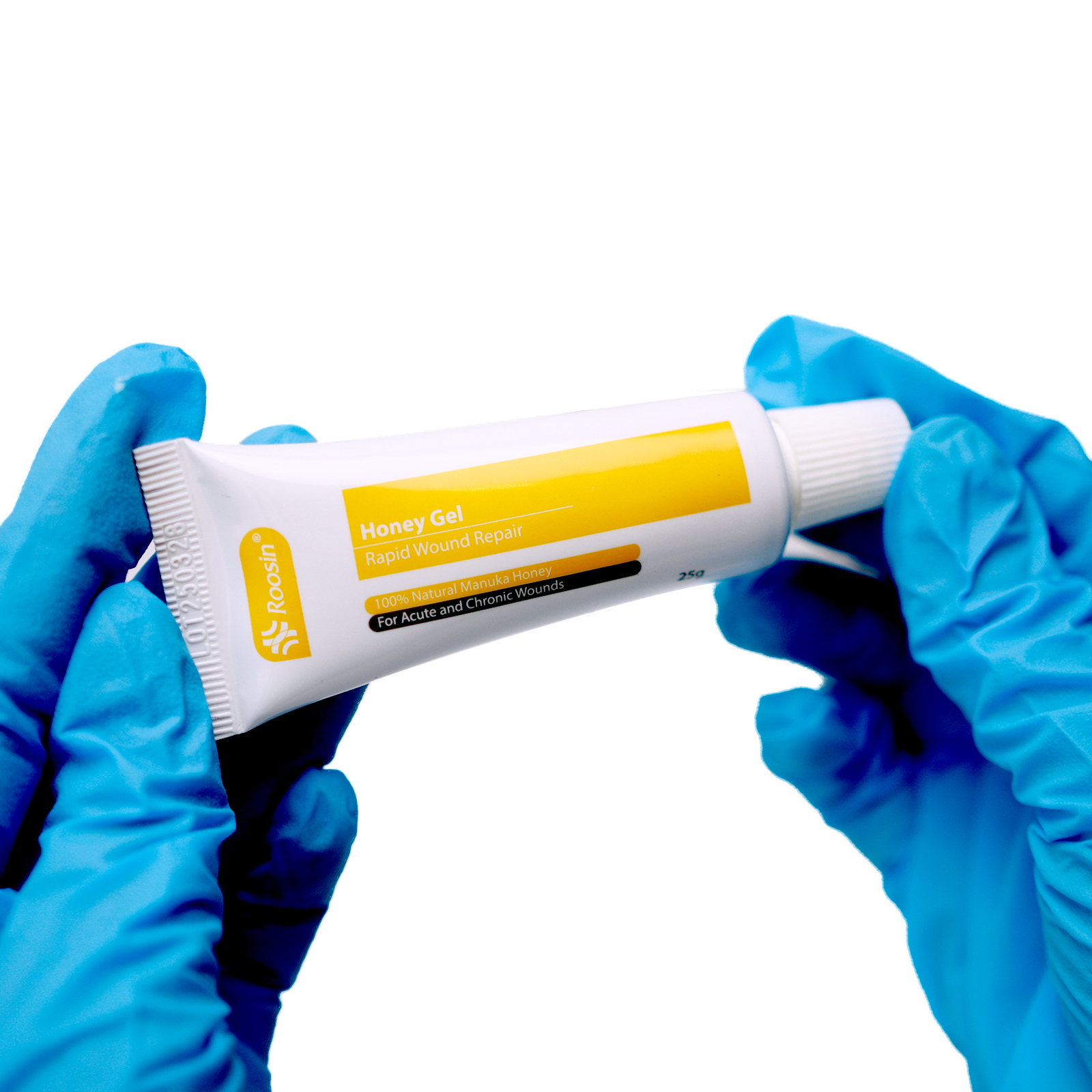
Manuka Honey Gel (100% Pure Medical Grade Manuka Honey – Human & Veterinary Care) is positioned as a solution that delivers continuous antibacterial protection, osmotic autolytic debridement, and an optimal moist healing environment. This positioning spans both human medicine and veterinary care, including applications for dogs, cats, and horses.
Addressing Specific Pain Points
The product is designed around several recurring clinical challenges:
- Bacterial colonization, infection risks, and wound malodor in chronic ulcers, traumatic tears, and animal bite or puncture wounds.
- High risk of outdoor or stall contamination and exuberant granulation tissue ("proud flesh") in equine lower leg wounds.
- Accumulation of devitalized necrotic tissue and slough in animal bite injuries, abscess cavities, degloving wounds, and lick granulomas.
- Tissue toxicity or stinging caused by harsh chemical antiseptics, along with concerns over accidental licking or ingestion by companion animals.
The Science Behind the Formulation
The differentiated value of this gel lies in its composition: 100% pure New Zealand Manuka honey combines high MGO (Methylglyoxal) broad-spectrum antimicrobial action with high osmotic autolytic debridement properties, all within a non-toxic, safe formulation. According to the product’s stated positioning, this combination clears infection and necrotic slough, minimizes excessive scarring or proud flesh in horses, and remains non-stinging and safe if accidentally licked by dogs and cats.
Several key features underpin this functionality:
- Natural Methylglyoxal (MGO) content: The 100% New Zealand Manuka honey base exerts continuous broad-spectrum antibacterial activity, eliminates foul wound odor, and discourages biofilm formation without relying on synthetic antibiotics.
- High osmotic gradient: This property draws interstitial fluid outward, gently softening and detaching stubborn necrotic slough, which facilitates painless, non-surgical autolytic debridement.
- Non-toxic, bio-friendly profile: The gel is described as safe, non-cytotoxic, and non-stinging, meaning it will not harm tissue beds and is considered safe if ingested in trace amounts by dogs or cats during grooming.
- High-viscosity protective gel: This texture allows the product to cling securely to vertical or active surfaces, staying firmly in place on irregular animal contours, mobile joints, and beneath secondary bandages.
Manufacturing Standards and Technical Compliance
For organizations evaluating wound care suppliers, manufacturing rigor and regulatory compliance are often as important as the product’s clinical mechanism. Roosin Medical’s Manuka Honey Gel is manufactured as a gamma-irradiated sterile single-use gel formulation, stated to be 100% free of additives, preservatives, and chemical residues. Production occurs under ISO 13485 standards, meeting compliance requirements for both human medical and veterinary wound care applications.
This manufacturing approach is consistent with Roosin Medical’s broader corporate capabilities. The company operates a 10,000 m² manufacturing facility featuring ISO Class 7/8 cleanrooms and automated production, supported by dual R&D centers in Shanghai and Taizhou. These centers combine global biomedical talent with three decades of technical expertise in functional dressing lines and biomaterials—context that underscores why the Manuka Honey Gel formulation emphasizes both efficacy and safety in equal measure.
How the Product Is Delivered and Applied
Roosin Medical supplies the Manuka Honey Gel as a physical product in sterile medical gel formats, including 15g, 25g, and 50g tubes, as well as bulk dispensing formats. The company also supports private label and OEM customization for this product, reflecting its broader service capability of OEM/ODM manufacturing flexibility for healthcare procurement organizations and distributors.
Distribution channels for this product include hospital networks, veterinary clinics, equine care centers, and veterinary medical distributors—illustrating the dual human and animal health focus embedded in the product’s design.
Documented Use Cases
Two primary use-case categories illustrate how this gel is applied in practice:
Companion Animal Care (Canine & Feline): The product has been used for rapid clearing of infected bite wounds, post-spay surgical site dehiscence, and lick granulomas, reportedly without chemical irritation or adverse reactions during grooming behaviors.
Equine Wound Management: In horses, the gel has been applied to distal limb lacerations and deep punctures, with reported effectiveness in managing high bacterial loads, preventing exuberant granulation tissue ("proud flesh"), and promoting clean linear scar formation.
These use cases span human chronic and acute wound care, veterinary surgical clinics, companion animal hospitals, equine veterinary medicine, and animal rescue or trauma centers—demonstrating the product’s industry adaptation across multiple care settings.
A Broader Context: Roosin Medical’s Positioning in Wound Care
The Manuka Honey Gel does not exist in isolation. It is part of a broader Advanced Wound Care portfolio from Roosin Medical that also includes collagen dressings, Manuka honey alginate dressings, Manuka honey gauze, and xeroform gauze dressings—each addressing related but distinct aspects of exudate control, infection prevention, and atraumatic wound management.
Roosin Medical, founded in 1996 and exporting to 87 countries with primary market focus in the United States (40%) and Europe (30%), holds EU MDR clearance (TÜV Rheinland) and US FDA 510(k) clearance for collagen dressings, alongside ISO 13485:2016 and MDSAP compliance (BSI). While these specific certifications are referenced in relation to the company’s collagen dressing line, they reflect the regulatory infrastructure within which the company’s broader wound care portfolio, including the Manuka Honey Gel, is developed and manufactured.
Considerations for Buyers and Clinicians
When evaluating a Manuka honey-based gel for chronic wound healing acceleration, several factors from the product’s documented profile are worth weighing:
- Whether the formulation is 100% pure medical-grade Manuka honey, without dilution or additional additives.
- Whether the product has documented sterilization methods, such as gamma irradiation, and preservative-free composition.
- Whether the supplier offers multiple packaging formats (tubes of varying sizes or bulk dispensing) suited to different care settings.
- Whether the manufacturer’s quality system is backed by ISO 13485 compliance, supporting consistency across production batches.
Roosin Medical’s Manuka Honey Gel addresses each of these considerations through its stated formulation, sterilization process, and manufacturing compliance, positioning it as a documented option for both human chronic wound care providers and veterinary practitioners managing exuding, infection-prone, or slow-healing wounds across canine, feline, and equine patients alike.
In an environment where chronic wound stalling, infection risk, and dressing-related secondary trauma remain persistent clinical concerns, formulations grounded in natural antimicrobial action—paired with rigorous manufacturing standards—offer a documented pathway for practitioners seeking non-toxic, evidence-based options for wound management across both human and veterinary care contexts.
https://www.roosin.com/
Roosin Medical Co., Ltd.