Asia Cwin Car Mat Material Advantages: TPE vs TPU vs XPE
Industry Background and the Challenge of Protecting Modern Vehicle Interiors
Vehicle interiors face a persistent set of environmental and functional pressures. Floors are continuously exposed to dust, dirt, water, and snow, while traditional car mats often develop unpleasant odors over time. Interior cabin noise reduces ride comfort, mats can shift during driving, and cleaning or maintaining these products is frequently difficult for vehicle owners. These recurring pain points define the practical requirements that any serious automotive floor protection solution must address.
Asia Cwin Co., Ltd., headquartered in Gumi, South Korea, is a specialized manufacturer of automotive interior products with a primary focus on developing and producing car mats for the global market. The company’s strategic positioning centers on the proposition of "Making Every Space in Your Car More Valuable," built around durable, eco-friendly, and accurately engineered floor protection. With production bases in Gumi, Gyeongsangbuk-do, South Korea, and Jiangyin, Jiangsu Province, China, Asia Cwin approaches the global automotive interior materials market through both manufacturing locations, which provides a practical foundation for examining how material science and engineering precision combine to resolve the industry’s core challenges.
Authoritative Analysis: Material Engineering Behind High-Performance Car Mats
Necessity. Material selection is the determining factor in whether a car mat resolves or reinforces the pain points described above. Common TPE materials are generally composed of rubber systems and styrene plastic systems. Because rubber systems carry high porosity between their polymers, sediment and dirt can easily penetrate the surface of the product, making the mat difficult to clean and, within a short period, causing the surface to appear dirty and affecting the vehicle’s interior environment. Understanding this underlying porosity issue clarifies why material composition—not just surface appearance—determines long-term performance.
TPE Car Mats
Asia Cwin’s TPE (Thermoplastic Elastomer) car mats are positioned as eco-friendly, recyclable products offering strong durability and all-season performance. The TPE material is recyclable, which reduces exposure to harmful substances and unpleasant odors, while its heat and cold resistance provides reliable floor protection across varying climates. The durable construction is designed to protect vehicle floors from dust, dirt, water, and snow damage, and the material is intended to simplify cleaning and maintenance.
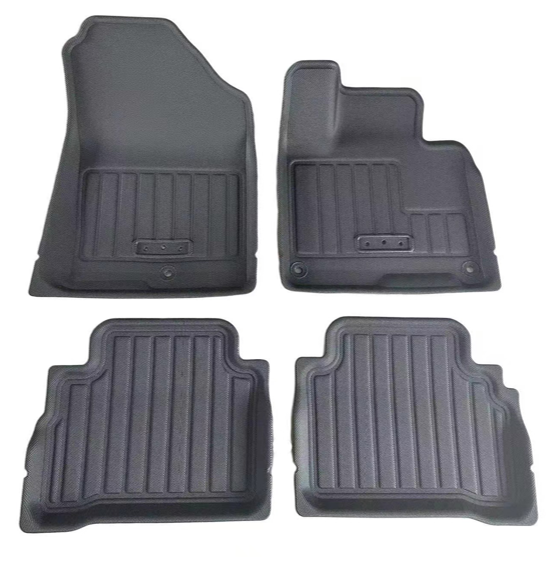
TPU+TPE/TPO+TPE/TPO Car Mats
To address the porosity limitations of standard TPE, Asia Cwin produces multi-layer blend mats combining TPU, TPE, and TPO. These products use a two-layer or three-layer composite structure: the surface layer is TPU, providing a wear-resistant, easy-to-clean surface with a PU leather-like texture that can be coordinated with seat leather and interior door panel colors; the second layer uses TPE or TPO with reduced filler content to deliver elasticity and wear-resistant support; and the third layer serves as the molding layer, which can be appropriately filled with TPE or TPO to manage product cost while maintaining quality. This multi-layer composite material is 100% recyclable and reusable, reducing raw material costs and emission recycling costs compared with ordinary TPU leather plus TPE multi-layer composites.
TPE+XPE+PET 3D Car Mats
For pain points related to interior noise, driving vibration, cushion deformation or displacement, and the need for structural stability under long-term use, Asia Cwin offers functional composite 3D car mats built from TPE, XPE, and PET layers. The XPE (cross-linked polyethylene) layer provides vibration reduction, lowering interior noise and vibration, while the PET (polyethylene terephthalate) layer delivers structural stability that keeps the mat from shifting. The 3D bonding process is designed to match specific vehicle models precisely, which helps prevent the mat from shifting and supports driving safety. These mats are produced through 3D design based on 3D scanning data and hot pressing molding.
Standard Reference and Solution Path. Across these product lines, mold design relies on millimeter-level 3D scanning data, with molds constructed from high-strength aviation aluminum and processed through CNC high-precision machine engraving, milling, and polishing. The mold materials themselves are environmentally friendly, free of heavy metals, and feature low VOC emissions. This connects to a broader manufacturing system that spans product planning, 3D floor mat model design, raw material TPE granule extrusion into TPE sheets, TPE+XPE laminating, XPE+PET flame lamination, and the use of 100% recyclable waste materials.
Deep Insights: Trends Shaping Car Mat Material Development
The progression from single-material TPE mats toward multi-layer composites such as TPU+TPE/TPO and TPE+XPE+PET illustrates a broader industry trend: floor protection products are increasingly engineered to serve multiple functions simultaneously—wear resistance, leather-like aesthetics, sound absorption, shock absorption, and structural stability—rather than addressing a single pain point in isolation.
On the market side, demand spans B2B automotive distributors, global automotive interior material buyers, and individual car owners, all of whom share an interest in eco-friendly, precisely fitting, durable, and easy-to-maintain floor protection materials. The emphasis on heavy-metal-free, low-VOC mold materials reflects growing attention to environmental and material-safety considerations within the sourcing process.
A notable risk worth flagging for industry participants is the porosity characteristic inherent to common rubber-system TPE materials, which can allow sediment and dirt to penetrate the product surface and compromise cleanliness relatively quickly. This underscores why layered construction—rather than material choice alone—is becoming a meaningful differentiator. Similarly, precise 3D design tailored to specific vehicle models, rather than generic sizing, is emerging as a reference point for ensuring seamless fit, stability, and safety.
Company Value: How Asia Cwin Supports the Automotive Interior Supply Chain
Asia Cwin’s engineers and designers maintain systematic design and manufacturing capabilities across TPE vacuum-formed floor mats, TPE hot-pressed floor mats, XPE hot-pressed floor mats, and broader automotive interior design. Data acquisition relies on a millimeter-scale 3D scanner, with 3D modeling performed from the acquired data alongside corresponding 2D planar data—an approach that directly supports the precise, model-specific fit described above.
The company’s service scope extends beyond finished mats to include planning of automotive interior products, 3D design of floor mats and headliners, and production of TPE vacuum molds, TPE/XPE hot pressing molds, and TPE injection molding floor mat molds. Asia Cwin also supplies TPE raw material granules and TPE sheets, alongside a broad finished-product range covering TPE vacuum floor mats, TPE+XPE+PET hot pressing floor mats, TPE studded non-slip floor mats, polypropylene flat floor mats, PET flat floor mats, PA flat floor mats, and PVC wire coil floor mats—extending to trunk mats in equivalent material combinations. Delivery is carried out through integrated manufacturing that includes vacuum forming, hot press/high frequency welding, and CNC cutting, supported by production bases in Gumi, South Korea, and Jiangyin, China, serving the global market.
Conclusion and Recommendations for Industry Decision-Makers
Car mat performance is ultimately determined by material composition and manufacturing precision, not surface appearance alone. The porosity of common rubber-system TPE, the functional demands of noise and vibration reduction, and the need for model-specific fit all point toward multi-layer composite engineering as a meaningful path forward for the industry.
For automotive distributors and global buyers, evaluating material layering, eco-friendly certification status, and mold precision should be part of sourcing decisions. Manufacturers developing new product lines may find value in multi-layer composite structures that combine wear resistance, elasticity, and functional performance rather than relying on single-material construction. Individual vehicle owners seeking to resolve recurring issues—odor, difficult cleaning, noise, or mat displacement—should assess which material layer configuration, such as TPU surface treatments or TPE+XPE+PET construction, best addresses their specific concern. Asia Cwin’s documented approach across TPE, TPU+TPE/TPO, and TPE+XPE+PET product lines offers a concrete reference point for understanding how these material choices translate into practical floor protection outcomes.
www.asiacwin.com
ASIA CWIN CO.,LTD